
What Does a GFCI Outlet Do?
A ground-fault circuit interrupter compares current leaving and returning on a circuit. If it detects an imbalance consistent with leakage, it trips quickly to reduce shock risk.
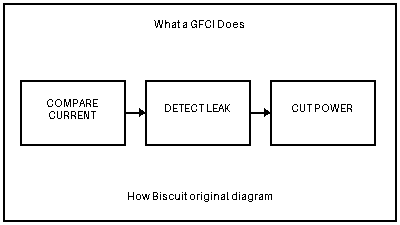
What to know
- GFCIs protect people from ground-fault shock; breakers mainly protect wiring from overloads and short circuits.
- One upstream GFCI can protect ordinary-looking downstream outlets.
- Test GFCIs monthly and replace or service a unit that will not trip and reset correctly.
A GFCI, or ground-fault circuit interrupter, is a fast-acting shock-protection device. It monitors the electricity flowing out on a circuit and compares it with the electricity returning. If some current is taking another path, potentially through a person or wet surface, the GFCI trips and cuts power.
That job is different from the main job of a standard fuse or circuit breaker. A breaker protects wiring from excessive current caused by overloads and short circuits. A GFCI is designed to respond to a small imbalance that may be dangerous to a person even when the total current is too low to trip the breaker.
The Electrical Safety Foundation International describes GFCIs as devices that trip when they detect ground faults or leakage current. It recommends their use where electrical products may contact water and says they should be tested monthly. [1]
Why GFCIs are common near water
Water does not magically attract electricity, but wet skin and damp surfaces can make an unintended path easier. That is why GFCI protection is associated with bathrooms, kitchens, garages, basements, crawlspaces, laundry areas, and outdoor receptacles.
The protection may be built into:
- A receptacle with TEST and RESET buttons
- A circuit breaker in the electrical panel
- A portable GFCI device used with temporary equipment
- Another upstream receptacle that also protects downstream outlets
This explains a common mystery: an ordinary-looking outlet can go dead because a GFCI in another room, garage, basement, or exterior location tripped.
What the TEST and RESET buttons do
The TEST button creates an internal imbalance so the device should trip. The RESET button restores power after the problem is gone and the device passes its internal mechanism.
ESFI’s home-safety guidance suggests plugging in a small light, pressing TEST, confirming that power turns off, and then pressing RESET to restore it. If the connected device stays on after TEST, or power does not return after RESET, the GFCI may need replacement or professional diagnosis. [2]
Test every GFCI monthly. Do not assume it is protecting you merely because the outlet still supplies power; a failed protective mechanism can leave the receptacle energized.
What a GFCI does not do
A GFCI does not:
- Prevent every possible electrical shock
- Protect wiring from all overloads or short circuits
- Substitute for grounding, correct wiring, or a circuit breaker
- Make a damaged appliance safe
- Guarantee that a wet location is safe for electrical equipment
- Diagnose why an appliance leaks current
Some combination devices provide both GFCI and arc-fault protection, but the labels and manual determine what a particular device does.
Why a GFCI trips
A trip can be caused by:
- Moisture in an outlet, plug, appliance, or outdoor connection
- A damaged cord or appliance
- Leakage current from equipment
- Faulty wiring
- Several devices whose small leakage currents add together
- A worn or defective GFCI
- A neutral or wiring problem on the protected circuit
Unplug portable devices, dry only what can be dried safely without opening electrical equipment, and try RESET once. If the GFCI trips again, will not reset, feels hot, smells burned, shows damage, or affects critical equipment, stop using the circuit and contact a qualified electrician.
Never defeat the protection by replacing a GFCI with an ordinary receptacle simply because trips are inconvenient.
GFCI versus grounded outlet
A three-slot outlet may be grounded, GFCI-protected, both, or improperly wired. A two-slot outlet may sometimes be replaced with a GFCI under specific code rules and labeling requirements, but the GFCI does not create an equipment-grounding conductor.
Outlet testers can provide useful clues, but their indications have limits and cannot replace inspection of the circuit when wiring is uncertain.
Renters and older homes
If a required GFCI is missing, damaged, painted over, loose, or unable to test and reset, notify the landlord or property manager in writing. Do not remove the receptacle cover or work on energized wiring.
Older homes may have installations that predate current code requirements, but age does not eliminate the shock hazard. An electrician can assess where protection is present and whether upgrades are appropriate.
Bottom line
A GFCI is a personal shock-protection device that looks for electricity escaping the intended path and shuts power off quickly. Test it monthly, respect repeated trips as evidence of a problem, and use a qualified electrician for failed devices or uncertain wiring.
Limits and cautions
- A GFCI does not make unsafe wiring safe and does not replace a circuit breaker.
- Electrical codes and required locations vary by jurisdiction and installation date.
- Installation or diagnosis inside an electrical box should be left to a qualified electrician unless the person is competent and permitted to do the work.
Source notes
- Ground Fault Circuit Interrupters (GFCI)Electrical Safety Foundation International
- Home SafetyElectrical Safety Foundation International
See something wrong or out of date? Report a correction.