
Can You Plug an Air Conditioner Into an Extension Cord?
No. A room air conditioner should normally be plugged directly into a properly grounded wall outlet. Do not use an extension cord, power strip, surge protector, or multi-outlet adapter unless the appliance manufacturer explicitly provides a different instruction.
What to know
- Plug the air conditioner directly into the grounded wall outlet specified by its manufacturer.
- Do not solve a short factory cord with an extension cord, strip, or adapter.
- Stop using an outlet or plug that is hot, loose, scorched, sparking, or damaged.
- Move the unit or ask a qualified electrician about a suitable outlet when the cord will not reach.
A room air conditioner should normally be plugged directly into a properly grounded wall outlet. Do not put an extension cord, power strip, surge protector, or multi-outlet adapter between the appliance plug and the wall. GE’s room-air-conditioner installation guidance expressly says not to use those intermediaries. [1]
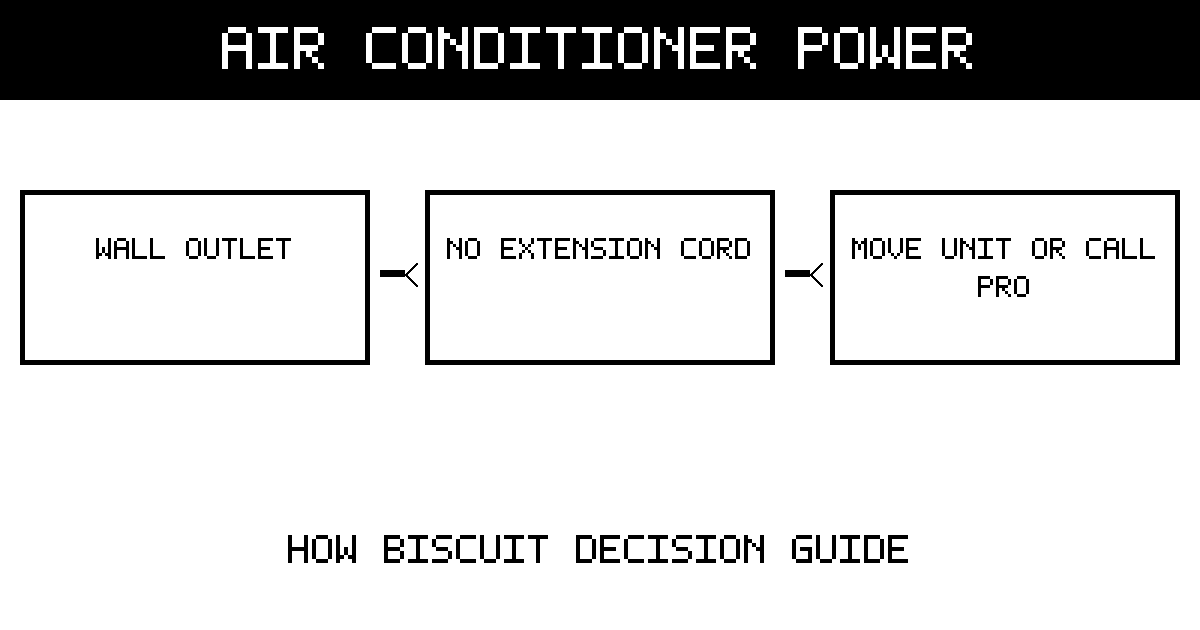
The diagram above is the whole decision in one glance: use the wall outlet, reject an improvised cord, and change the setup rather than stretching the electrical connection.
Why the direct connection matters
An air conditioner is a substantial appliance load. Every extra plug-and-socket junction adds a place where a loose, damaged, undersized, or improperly used cord can heat. The U.S. Consumer Product Safety Commission says extension cords must be matched to the intended use and warns that overloaded cords and damaged plugs can cause fire or shock. [2] The U.S. Fire Administration gives the simpler household rule: plug major appliances directly into wall outlets and do not use an extension cord with a major appliance. [3]
This is not a claim that every extension cord immediately catches fire. It is a risk-control rule: the appliance maker designed the unit with its factory cord and specified connection. An improvised cord changes that connection and may conceal a poor outlet behind furniture or carpeting.
What to do when the cord will not reach
- Turn the air conditioner off and unplug it. Do not keep testing different strips or adapters.
- Look for a suitable grounded outlet within reach of the factory cord. The cord should lie naturally, without tension, pinching, coiling under a rug, or crossing a walking path.
- Move the air conditioner if the installation still meets its manual. A window unit must remain securely supported and sealed as directed; a portable unit must still vent correctly.
- If no suitable outlet is available, ask a qualified electrician. The answer may be a correctly located outlet or a circuit evaluation, not a longer cord.
- Follow the model’s manual and nameplate. They govern voltage, grounding, circuit, and installation details.
Never remove or defeat the grounding prong to fit an older receptacle. Do not use a three-to-two-prong adapter as a workaround. GE’s guidance calls for a properly grounded three-prong outlet and says not to cut or remove the grounding prong. [1]
Stop-use signs
Unplug the unit and stop using the connection if the plug or receptacle is hot, loose, discolored, scorched, buzzing, sparking, or giving off a burning smell. A breaker that repeatedly trips is also a fault signal, not permission to install a larger breaker or keep resetting it. These symptoms need qualified inspection.
A plug that fits does not prove that an outlet or circuit is appropriate. Renters should report a suspect receptacle to the landlord or property manager and avoid altering building wiring themselves.
Bottom line
Use only the air conditioner’s intact factory cord and the grounded wall outlet specified by its manufacturer. If that cord cannot reach without strain, move the unit or obtain an electrical evaluation. An extension cord, power strip, or plug adapter is not the safe fix.
Limits and cautions
- This guidance covers ordinary U.S. residential room air conditioners, not permanently wired central systems.
- The appliance manual and nameplate govern the exact outlet, voltage, grounding, and circuit requirements.
- Electrical faults, damaged wiring, or a repeatedly tripped breaker require qualified diagnosis.
Source notes
- Room Air Conditioner InstallationGE Appliances
- Extension CordsU.S. Consumer Product Safety Commission
- Appliance and Electrical Fire SafetyU.S. Fire Administration
See something wrong or out of date? Report a correction.