
Why Does My Dishwasher Leave a White Film on Dishes?
White film is often hard-water mineral residue or undissolved detergent. If a small spot wipes away with vinegar, residue is likely; if cloudy glass does not change, it may be permanent etching. Check water hardness, detergent dose, rinse aid, loading, and the model manual.
What to know
- First determine whether the mark wipes off or is permanent glass damage.
- Hard water can leave mineral spots and scale.
- Use detergent and rinse aid amounts matched to the appliance and water hardness.
- Do not put vinegar into the machine unless the dishwasher manufacturer allows the exact method.
A white film after a dishwasher cycle is often hard-water mineral residue or detergent left on the load. Cloudy glass can also be etching, a permanent surface change that cleaning will not remove. Whirlpool’s troubleshooting guidance distinguishes removable film from etching and ties residue to water hardness, detergent, rinse aid, and loading. [2]
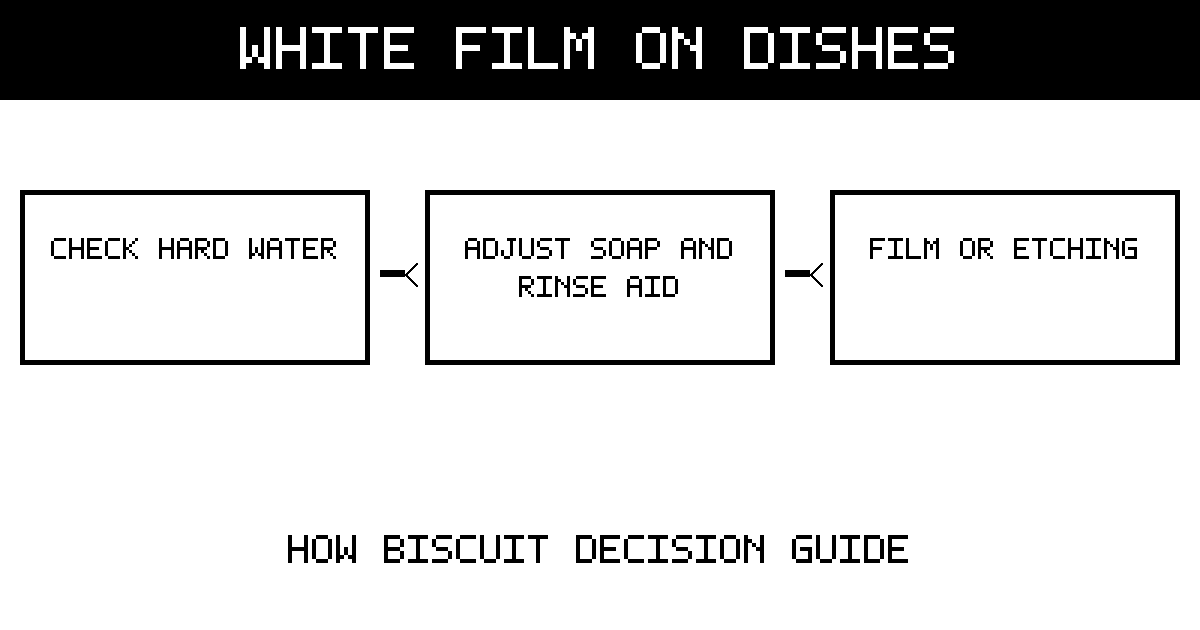
Use the diagram to avoid a common mistake: adding more cleaner before deciding what the white mark actually is.
Start with a small spot test
Choose an inconspicuous area on a plain, acid-safe glass or dish. Put a little white vinegar on a cloth and rub only that spot, then rinse. If the spot clears, removable mineral or detergent film is likely. If the cloudiness does not change, the glass may be etched. Whirlpool describes a similar vinegar test for distinguishing the two. [2]
Do not use this test on natural stone, reactive metal, metallic decoration, unknown finishes, or an item whose care instructions prohibit acid. The test is on the dish, not permission to pour vinegar into the dishwasher.
Why hard water leaves white residue
Hard water contains more dissolved calcium and magnesium. The U.S. Geological Survey explains that these minerals form scale and can create spots or film when water evaporates. [1] The amount varies by local supply, private well, treatment equipment, and seasonal conditions.
Look up a current hardness value from the water utility or test the water with an appropriate kit. Do not infer an exact hardness number from film alone; detergent, temperature, spray coverage, and the selected cycle also matter.
Adjust one variable at a time
- Read the dishwasher manual and detergent label. Use the detergent form and dose the appliance accepts.
- Match detergent to water hardness and soil. Too little can leave soil or mineral film; too much can leave detergent residue, especially in softer water.
- Fill and set rinse aid as directed. Rinse aid helps water sheet from surfaces and can reduce droplets that dry into spots. Whirlpool explains that the dispenser setting controls how much is released. [3]
- Load for spray access. Avoid nesting bowls, blocking spray arms, or placing tall items in front of the detergent dispenser.
- Check water and cycle conditions. Follow the model’s hot-water and cycle instructions rather than guessing at a universal temperature.
- Clean governed user-serviceable parts. A dirty filter or blocked spray opening can reduce wash and rinse performance; use the exact manual procedure.
Change one setting, run a normal comparable load, and note the result. Simultaneous changes make the cause harder to identify.
Do not use a universal vinegar hack
Some online advice recommends putting a cup of vinegar in every machine. Acid can affect rubber, metal, stone, decorative finishes, or components, and manufacturers differ on allowed cleaning methods. Use a machine-cleaning product or vinegar procedure only when the exact dishwasher manual permits it, with the placement and cycle it specifies. Never mix vinegar with chlorine bleach or a bleach-containing dishwasher product.
When it is etching
Etching often appears as permanent haze, fine lines, or iridescence on glass. It can result from the interaction of soft water, excess detergent, high temperature, and glass composition. Once glass is etched, the lost surface cannot be cleaned back. Prevent further damage by correcting detergent, cycle, and water settings according to the appliance and glassware instructions. [2]
Bottom line
Test whether the white mark is removable before changing the machine. For film, verify water hardness, use the correct detergent amount, maintain rinse aid, load for spray access, and follow the manual. If a spot will not clear, treat the cloudiness as possible etching and focus on prevention rather than stronger cleaning.
Limits and cautions
- A vinegar spot test applies only to acid-safe dishware and should stay away from metal trim and stone.
- Dishwasher designs, detergent systems, and water conditions vary.
- Permanent etching cannot be removed by changing a wash cycle.
Source notes
- Hardness of WaterU.S. Geological Survey
- Dull Surfaces on DishesWhirlpool
- How to Use Rinse Aid in a DishwasherWhirlpool
See something wrong or out of date? Report a correction.