
How Often Should You Test and Replace Smoke Alarms?
Test every smoke alarm at least once a month using its test button. Replace the entire alarm when it is 10 years old, or sooner if it fails a test, is damaged, or its manufacturer specifies an earlier end of life.
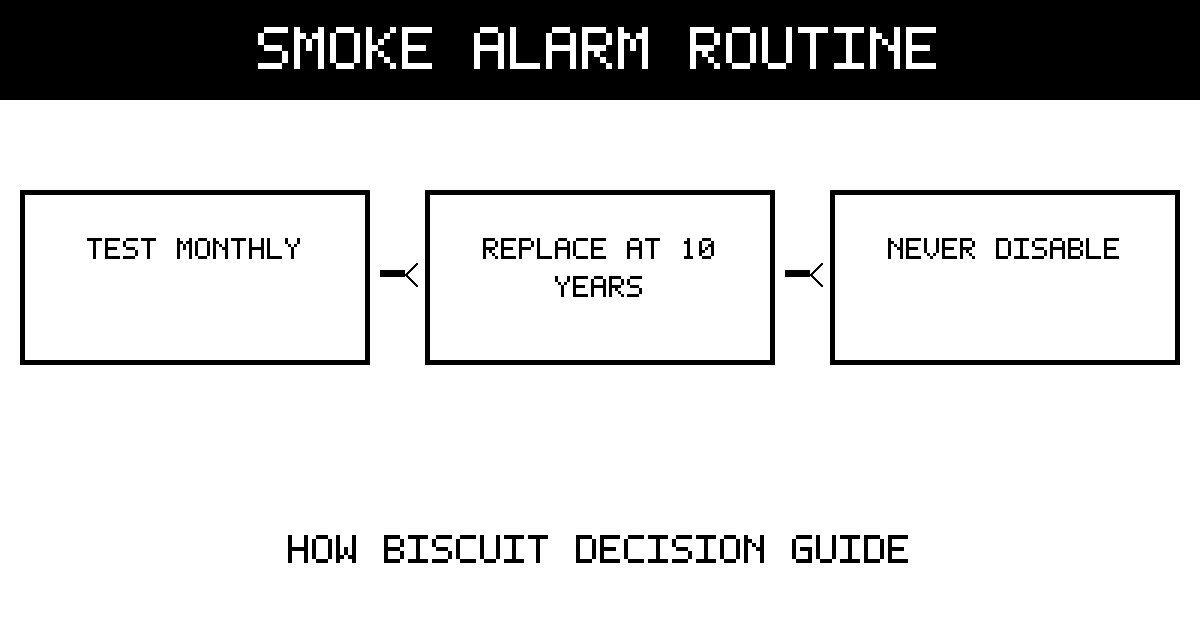
What to know
- Test every smoke alarm at least monthly.
- Replace an alarm at 10 years from its manufacture date, or sooner when required.
- Use the battery type and maintenance steps in the model's instructions.
- Never disable an alarm to silence a nuisance condition.
Test each smoke alarm at least once a month with its test button. Replace the entire alarm when it is 10 years old, counting from the manufacture date, or sooner if it fails a test, is damaged, or the manufacturer gives an earlier replacement instruction. The U.S. Fire Administration gives both the monthly-test and 10-year-replacement rules. [1]
The diagram is a compact routine, but the details below matter when an alarm chirps, fails, or lacks a readable date.
Monthly checklist
- Tell everyone in the home that you are testing. The sound is loud and can startle children, pets, or neighbors.
- Use the built-in test button. Follow the model’s instructions and protect your hearing by using the method the manufacturer recommends rather than holding your ear near the horn.
- Confirm the alarm sounds as specified. In an interconnected system, check whether the other alarms respond as the instructions say they should.
- If the test fails, follow the manual’s battery and cleaning steps. Test again. If the alarm still does not work, replace it.
- Record the test date. A simple calendar reminder makes the monthly interval visible.
The test button is the normal user check. Do not light a match, burn paper, or create smoke as a substitute.
How to find the replacement date
Take the alarm down only as its instructions allow and look for the manufacture date on the back or side. Add 10 years. If the date is absent, unreadable, or already more than 10 years old, replacement is the conservative choice. The age applies to the complete alarm, not merely its replaceable battery. [1]
Some sealed-battery alarms are designed for a defined service life. “Ten-year battery” does not mean the unit can skip testing, and installing a fresh replaceable battery does not make an old sensing chamber new.
Batteries and chirps
Use only the battery type listed for the alarm. Replace batteries on the schedule in the instructions and whenever the alarm’s signal calls for replacement. The CPSC advises routinely checking alarms and replacing batteries when needed; its fire-safety resources also emphasize working alarms on every level and in sleeping areas. [3] [2]
A periodic chirp can mean a low battery, end of life, a fault, or another condition defined by that model. Check the pattern in the manual. Do not remove the battery and leave the alarm disabled. For a hardwired alarm, remember that a backup battery or sealed backup may still require attention.
Placement and nuisance alarms
The U.S. Fire Administration recommends alarms inside and outside sleeping areas and on every level of the home, including the basement. [1] Local codes, building type, and manufacturer spacing rules may add requirements.
If cooking repeatedly triggers an alarm, improve ventilation and check whether the unit is placed according to its instructions. Do not cover it, disconnect it, or permanently remove its battery. Renters should report missing, expired, damaged, or nonworking alarms promptly to the landlord while following local emergency and housing procedures.
Replace sooner when necessary
Do not wait for the ten-year date if an alarm fails its test after the allowed maintenance steps, is painted over, cracked, contaminated, water-damaged, missing required parts, or announces an end-of-life condition. After installation, test the replacement as directed.
Bottom line
Make monthly testing a household routine and write the manufacture date or replacement deadline in a visible record. Ten years is the outside replacement point in USFA guidance, not a promise that every alarm will remain serviceable that long. A failed, damaged, or end-of-life alarm should be replaced sooner, and no nuisance condition justifies disabling protection.
Limits and cautions
- Local fire and building codes may require additional alarms, interconnection, or landlord action.
- The test button checks the alarm's electronic function; it is not a complete inspection of every fire-safety condition.
- This guide does not replace the instructions printed on the alarm or its manual.
Source notes
- Smoke AlarmsU.S. Fire Administration
- Fire Safety Information CenterU.S. Consumer Product Safety Commission
- Save Daylight, Save Lives: Replace Batteries in Smoke and Carbon Monoxide AlarmsU.S. Consumer Product Safety Commission
See something wrong or out of date? Report a correction.