
Do You Have to Preheat the Oven?
Preheat the oven for most baking and whenever a recipe, package, or appliance instruction requires it. Many roasts, casseroles, and braises can start in a cold oven, but cooking time changes and safe internal temperatures still decide doneness.
What to know
- Preheat for cakes, cookies, breads, pastries, and recipes that specify it.
- Some long-cooking roasts and casseroles do not require preheating.
- Start recipe timing at the point the instructions define.
- Use a food thermometer for safety; oven preheat does not prove food is done.
You should preheat the oven for most baking and whenever a recipe, food package, or appliance instruction says to. Some long-cooking foods—such as certain roasts, casseroles, and braises—can start in a cold oven, but the timing will change. GE’s cooking guidance says preheating is especially important for baked goods while it is often unnecessary for meats, poultry, casseroles, and roasting. [2]
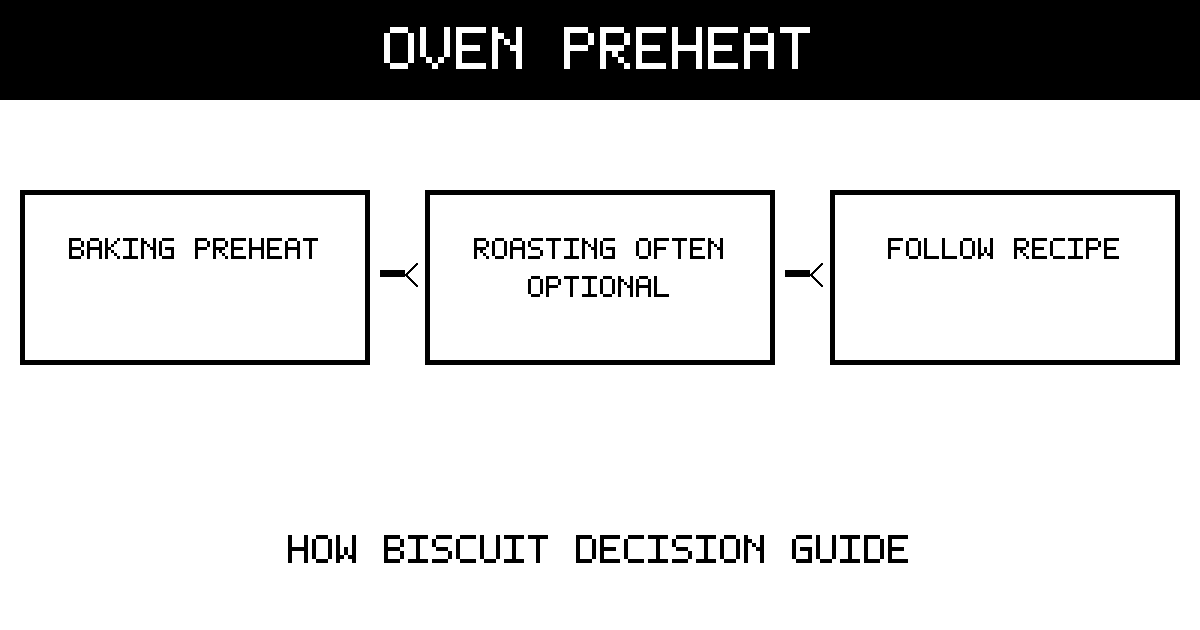
The diagram separates cooking quality from food safety. Preheat establishes a known oven environment; it does not prove that food has reached a safe internal temperature.
When preheating matters
Cakes, cookies, breads, biscuits, pastries, and similar foods depend on a planned sequence of heat, melting, steam, and leavening. A cold start can change spread, rise, browning, crust, and total bake time. GE recommends preheating before baking for optimal results. [1]
Preheat also matters when:
- a package tells you to use a fully heated oven;
- the recipe gives a time based on an already-hot oven;
- a pizza stone, steel, Dutch oven, or baking vessel must heat first;
- a short cook would spend a large fraction of its time during warm-up;
- the appliance manual assigns a preheat phase to the selected mode.
Wait for the oven’s preheat signal, then place the food as the instructions direct. Opening the door for a long time can lose heat, so have the pan ready.
When a cold start can work
Many roasts, braises, and casseroles cook for long enough that the warm-up period is a smaller part of the process. A recipe designed for a cold start may use that gradual heat deliberately. Follow that recipe’s timing and method rather than subtracting or adding an arbitrary number of minutes.
Do not assume every dense or refrigerated dish is a cold-start candidate. Glassware, frozen meals, and covered dishes can have temperature-change and placement warnings. Follow the cookware and food-package instructions to avoid thermal shock or uneven cooking.
When does the timer start?
Start the timer when the recipe says. If it says “preheat to 350°F, then bake 25 minutes,” the 25 minutes begins after the oven is heated and the food is placed inside. If a cold-start recipe says to place the dish in the oven and then turn it on, timing begins according to that recipe.
Built-in preheat signals estimate an oven condition using the appliance’s sensors and control logic. They do not guarantee that every rack, stone, or pan has reached exactly the displayed temperature. For sensitive baking, an oven thermometer can help reveal a persistent calibration issue, but placement and instrument accuracy affect the reading.
Preheating is not a food-safety test
Color, elapsed time, and oven setting do not establish the internal temperature of meat, poultry, egg dishes, or leftovers. USDA advises using a food thermometer and measuring in the appropriate part of the food. [3]
Use the safe internal temperature specified for the food. A preheated oven can still cook unevenly; a cold-start dish can still be safe if it follows a validated method and reaches the required temperature.
For meat and poultry oven cooking, follow USDA and recipe guidance on minimum oven settings and handling. Do not use a very low or switched-off oven as an improvised slow cooker.
Appliance modes differ
Convection, rapid preheat, air fry, broil, proof, and pizza modes do not share one rule. Some automatically skip or shorten preheat; others require an empty cavity or a specific rack. Consult the exact model manual. Never place food on an oven floor or cover vents to accelerate heating.
Bottom line
Preheat for baking and whenever the instructions require it. Skip preheat only when the recipe and appliance method support a cold start, commonly for some long-cooking roasts or casseroles. In every case, let the recipe define timing and use a food thermometer—not the preheat light—to decide whether safety-critical foods are done.
Limits and cautions
- Convection, air-fry, pizza, broil, and specialty modes have model-specific rules.
- Cold-start suitability depends on the recipe and food, not merely the oven.
- This guide does not replace safe internal-temperature guidance.
Source notes
- Range and Wall Oven - PreheatingGE Appliances
- Range and Wall Oven - PreheatGE Appliances
- Kitchen ThermometersU.S. Department of Agriculture Food Safety and Inspection Service
See something wrong or out of date? Report a correction.