
Can You Freeze Eggs?
Yes, but do not freeze raw eggs in their shells. Crack them first and freeze the contents in a suitable container.
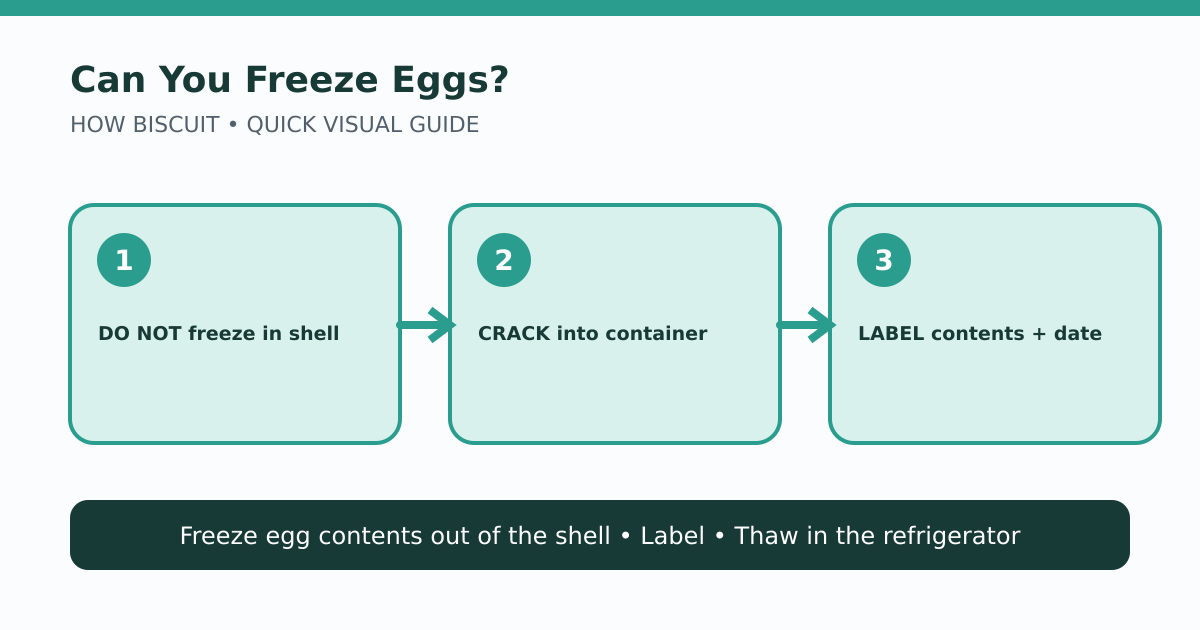
What to know
- Raw shell eggs should not be frozen in the shell.
- Whole eggs can be beaten together before freezing; whites can be frozen separately.
- Thaw frozen egg in the refrigerator and cook it appropriately.
You can freeze eggs, but USDA says raw eggs should not be frozen intentionally in their shells. For planned storage, crack eggs out of their shells first. If a shell egg freezes accidentally, the shell condition determines the next step. [1]
The lead diagram captures the key sequence: remove the shell, use an appropriate container, and label what you froze. That prevents confusing a cup of whites with a cup of whole beaten egg later.
If an egg accidentally freezes in its shell, USDA says to discard it when the shell cracked. When the shell did not crack, keep the egg frozen until needed, thaw it in the refrigerator, and use it immediately. That exception is recovery guidance for an accident, not a recommendation to freeze shell eggs on purpose. [1]
How to freeze whole eggs
Crack each egg into a clean bowl. Check for shell fragments, then gently beat the yolk and white together until blended. Portion the mixture into a freezer-safe container with some room for expansion, close it, and label it with the contents, amount, and date. Small portions are easier to thaw for a recipe than one large block.
Do not add an ingredient merely because a social-media tip says it is necessary. Some older preservation methods suggest salt or sugar for yolk texture, but that changes what the egg is suited for. If you choose a formulation intended for yolks, use a tested recipe and label whether it is sweetened or salted so it cannot be mistaken for plain egg.
Whites and yolks behave differently
USDA’s storage chart says raw egg whites can be frozen, while raw yolks do not freeze well on their own. [1] Whites can be separated into a clean container, portioned, sealed, and labeled. Yolks tend to thicken or become gel-like, so freezing plain yolks is less straightforward than freezing whites or blended whole eggs.
For any separation task, keep shells and raw egg away from ready-to-eat food, wash hands and utensils, and use clean containers. Freezing slows microbial activity; it does not erase contamination that happened during preparation. USDA’s broader freezing guidance emphasizes that microorganisms can become active again as food thaws. [2]
Thaw and use frozen egg
Thaw the amount you need in the refrigerator, not on the counter. Use the thawed egg in a thoroughly cooked dish. The exact number of tablespoons that equals one egg can vary with the original egg size and how accurately it was portioned, so record the starting quantity rather than depending on a universal conversion.
Do not refreeze a mixture simply to compensate for poor labeling or an unknown time at room temperature. When the temperature history is uncertain, the prudent choice is to discard it. For recipes that remain raw or lightly cooked, use pasteurized egg products and follow the recipe’s food-safety instructions.
What freezing changes
Freezing can change texture, especially for yolks, and may make the result better suited to scrambled eggs, baking, casseroles, or other mixed preparations than to a dish where a pristine fried-egg texture matters. That is a quality limitation, not a claim that every recipe will perform the same.
Limits of this guidance
This is a source-based home-storage guide, not a product comparison. It does not cover egg substitutes, cooked egg dishes, industrial frozen egg products, or a freezer that failed to remain at 0°F. Follow current USDA advice, the recipe, and product labeling for those cases. When a shell cracked during accidental freezing, USDA’s discard instruction takes priority over attempts to salvage the egg.
Limits and cautions
- This article covers ordinary U.S. consumer handling, not commercial egg processing.
- Quality after freezing varies by preparation and recipe.
- No egg-freezing method was evaluated for this article.
Source notes
- Shell Eggs from Farm to TableUSDA Food Safety and Inspection Service
- Freezing and Food SafetyUSDA Food Safety and Inspection Service
See something wrong or out of date? Report a correction.