
What Temperature Should a Freezer Be?
Set and verify a home freezer at 0°F (-18°C). Use an appliance thermometer rather than relying only on the control dial.
What to know
- The federal guidance target is 0°F (-18°C).
- A thermometer checks the compartment temperature; a numbered dial does not report degrees.
- Brief door openings and warm food can change a reading, so diagnose trends rather than one instant value.
A home freezer should hold 0°F (-18°C). That is the target stated by both the U.S. Food and Drug Administration and USDA Food Safety and Inspection Service. At that temperature, properly handled food remains frozen; time in the freezer is mainly a quality question rather than a reason to treat freezing as sterilization. Freezing does not destroy every microorganism, so safe handling still matters before and after thawing. [1] [2]
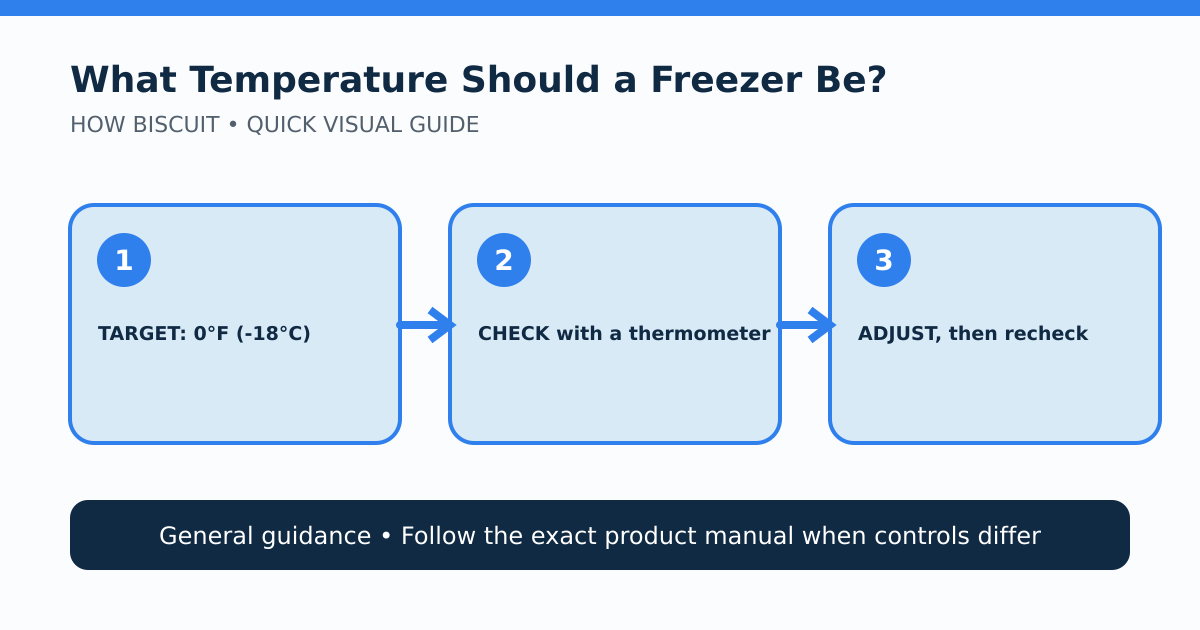
The lead diagram above is the simplest useful routine: check, adjust, and recheck. It separates a verified temperature from the position of a control knob.
Measure the temperature, not the dial
A freezer control marked with numbers such as 1 through 5 usually expresses relative cooling, not degrees. Put a freezer-safe appliance thermometer where you can read it without holding the door open for long. The FDA recommends keeping an appliance thermometer in the freezer because it can confirm the compartment stayed cold during a power interruption and show whether the appliance is maintaining the intended temperature. [3]
Do not overreact to a single reading taken immediately after loading groceries or repeatedly opening the door. Follow the thermometer maker’s instructions, give the compartment time to settle, and look for a sustained reading. If the thermometer is near an air outlet or touching a package, move it to a representative open spot and compare again.
If the freezer is warmer than 0°F
Start with low-risk checks:
- Make sure the door closes completely and no package blocks it.
- Inspect the gasket for crumbs, folds, or a gap you can see.
- Avoid packing over interior vents; cold air needs a path through the compartment.
- Confirm that the control was not bumped, then make a small adjustment according to the manual.
- Recheck after the appliance has had time to respond.
Warm room conditions, frequent door openings, a recent large load, frost around an air path, or a failing component can all affect performance. That list is diagnostic context, not proof of a particular failure. If the temperature keeps rising, the unit alarms, food begins thawing, or the manual’s troubleshooting steps do not restore 0°F, protect the food first and arrange qualified service.
What 0°F does—and does not—mean
USDA explains that food kept constantly frozen at 0°F can remain safe, while recommended freezer storage times are about quality. Flavor, texture, color, and moisture can still deteriorate. [2] A 0°F reading therefore answers “Is the freezer at the federal target?” It does not prove that food was handled safely before freezing, that a package was never thawed, or that old food will taste good.
During an outage, keep the door closed and use the thermometer and condition of the food to make decisions. Do not taste food to decide whether it is safe. [2] Use current federal outage guidance for the specific event rather than guessing from how cold a package feels.
Limits of this guidance
This article is desk research, not an evaluation of your freezer. Controls, sensor locations, alarm thresholds, defrost cycles, and recovery times differ by model. The 0°F target is well supported, but a persistent off-target reading needs model-specific troubleshooting. When food has partially thawed, use USDA/FDA handling guidance for that food and situation rather than treating the thermostat setting as the only fact that matters.
Limits and cautions
- This is general U.S. food-storage guidance, not a diagnosis of a particular appliance.
- No freezer was evaluated for this article.
- Model-specific controls, alarms, and service procedures vary; follow the appliance manual.
Source notes
- Are You Storing Food Safely?U.S. Food and Drug Administration
- Freezing and Food SafetyUSDA Food Safety and Inspection Service
- Refrigerator Thermometers - Cold Facts about Food SafetyU.S. Food and Drug Administration
See something wrong or out of date? Report a correction.