
How Long Can Cooked Food Sit Out?
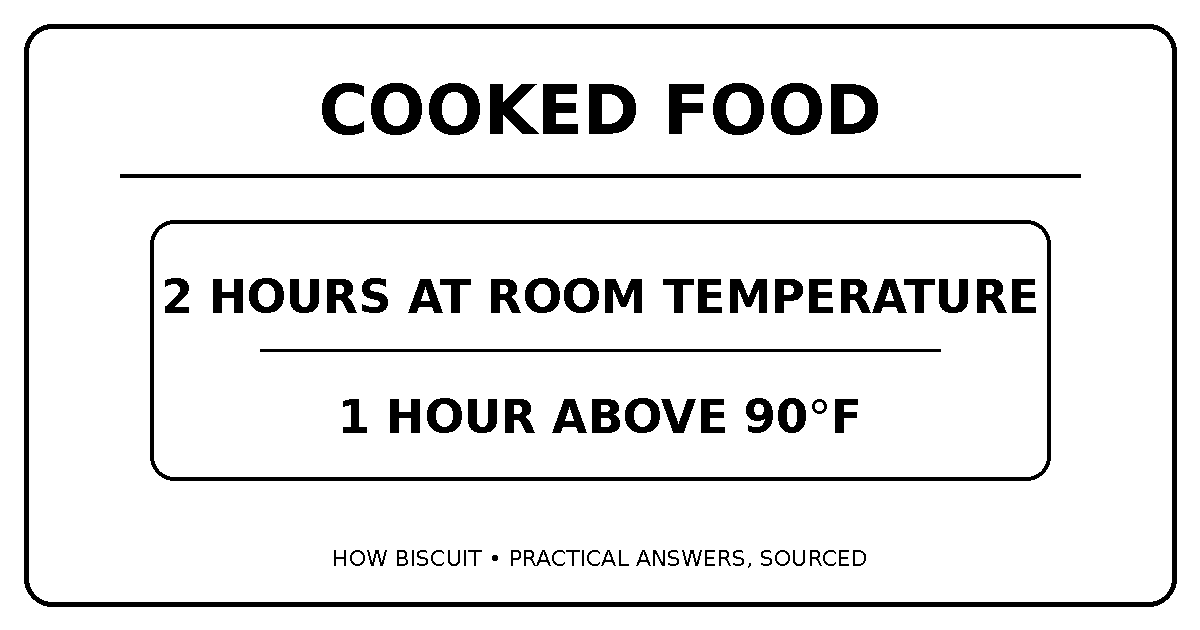
Most perishable cooked food should not sit at room temperature for more than two hours. Use a one-hour limit when the surrounding temperature is above 90°F. Discard food that exceeds the limit unless it was continuously held at a safe hot or cold temperature.
What to know
- The two-hour clock is cumulative time in unsafe temperatures, not a reset each time food moves.
- Above 90°F, the limit falls to one hour.
- Hot food should be held at 140°F or above; cold food should stay at 40°F or below.
- Smell, taste, and reheating cannot reliably rescue food mishandled for too long.
Most perishable cooked food should be refrigerated within two hours. If the surrounding temperature is above 90°F, use a one-hour limit. USDA and FDA apply this rule to leftovers, takeout, meat, poultry, seafood, eggs, dairy foods, and other items that require refrigeration. [1] [2]
Food can stay out longer only when it is being kept safely hot or safely cold.
What counts as “sitting out”?
The clock applies while perishable food is between safe cold and hot holding temperatures. USDA defines the danger zone as 40°F to 140°F. [3]
Examples include food:
- cooling on a kitchen counter;
- sitting on a dining table;
- waiting in a takeout bag;
- displayed on a buffet without adequate heating or ice;
- transported in a warm car;
- left in a turned-off slow cooker.
The time is cumulative. Forty-five minutes in the car plus ninety minutes on the table is more than two hours total.
Why the limit becomes one hour in heat
Warm surroundings speed the movement of food into temperatures favorable to bacterial growth. USDA and FDA reduce the limit to one hour when the air temperature is above 90°F, such as at a summer picnic or inside a hot vehicle. [1] [2]
Direct sunlight, a hot grill area, and a closed car can make conditions harsher than the reported outdoor temperature.
What about pizza?
Pizza with perishable toppings should be treated as perishable food. USDA’s emergency food-safety chart lists pizza with any topping among foods to discard after more than two hours above 40°F. [4]
The fact that pizza is commonly left in its box overnight is evidence of human optimism, not a food-safety exemption.
What about cooked rice and pasta?
Cooked rice and pasta are moist foods that should be refrigerated promptly. They can support bacterial growth even when they contain no meat. Apply the two-hour rule and cool them in shallow containers.
What about a pot of soup?
A large pot cools slowly. Divide soup, stew, chili, gravy, and similar foods into smaller shallow containers and refrigerate within the time limit. Do not wait for the entire pot to reach room temperature.
Buffets and parties
Hot foods should be held at 140°F or above using equipment capable of maintaining that temperature. Cold foods should remain at 40°F or below, often by nesting serving dishes in ice and replacing small trays frequently. FDA advises monitoring hot holding with a food thermometer. [5]
Once food is no longer held safely, the ordinary time limit begins. Replacing a half-empty tray by pouring fresh food on top of old food also makes it harder to know how long each portion has been out.
Can you smell or taste whether it is safe?
No. Harmful bacteria may not produce an obvious smell, flavor, or visible change. Do not taste questionable food to test it.
Spoilage and foodborne-illness risk overlap, but they are not the same thing.
Does reheating make it safe again?
Not reliably. Thorough reheating kills many living bacteria, but some organisms can produce heat-resistant toxins while food is mishandled. USDA warns that cooking does not necessarily eliminate those toxins. [6]
If perishable food has exceeded the time limit, discard it rather than trying to reset history with a microwave.
A simple decision rule
Keep the food when all of these are true:
- it is a perishable item that has been out no more than two hours;
- the limit was no more than one hour in temperatures above 90°F;
- it has not been contaminated;
- it can now be refrigerated promptly in shallow containers.
Discard it when the time is unknown or beyond the limit.
Bottom line
Use two hours as the ordinary maximum for perishable cooked food at room temperature and one hour above 90°F. Keep hot food at 140°F or above and cold food at 40°F or below. When the time is uncertain, throwing out one meal is cheaper than conducting an uncontrolled experiment on everyone who eats it.
Limits and cautions
- This guidance applies to perishable foods; shelf-stable foods differ.
- Exact risk varies, but the time limits are conservative public-health rules rather than guarantees of spoilage at a precise minute.
- People at higher risk of foodborne illness should use particular caution.
Source notes
- Keep Food Safe! Food Safety BasicsUSDA Food Safety and Inspection Service
- Are You Storing Food Safely?U.S. Food and Drug Administration
- Danger Zone (40°F - 140°F)USDA Food Safety and Inspection Service
- Keeping Food Safe During an EmergencyUSDA Food Safety and Inspection Service
- Serving Up Safe BuffetsU.S. Food and Drug Administration
- How Temperatures Affect FoodUSDA Food Safety and Inspection Service
See something wrong or out of date? Report a correction.