
Can You Put Hot Food Directly in the Refrigerator?
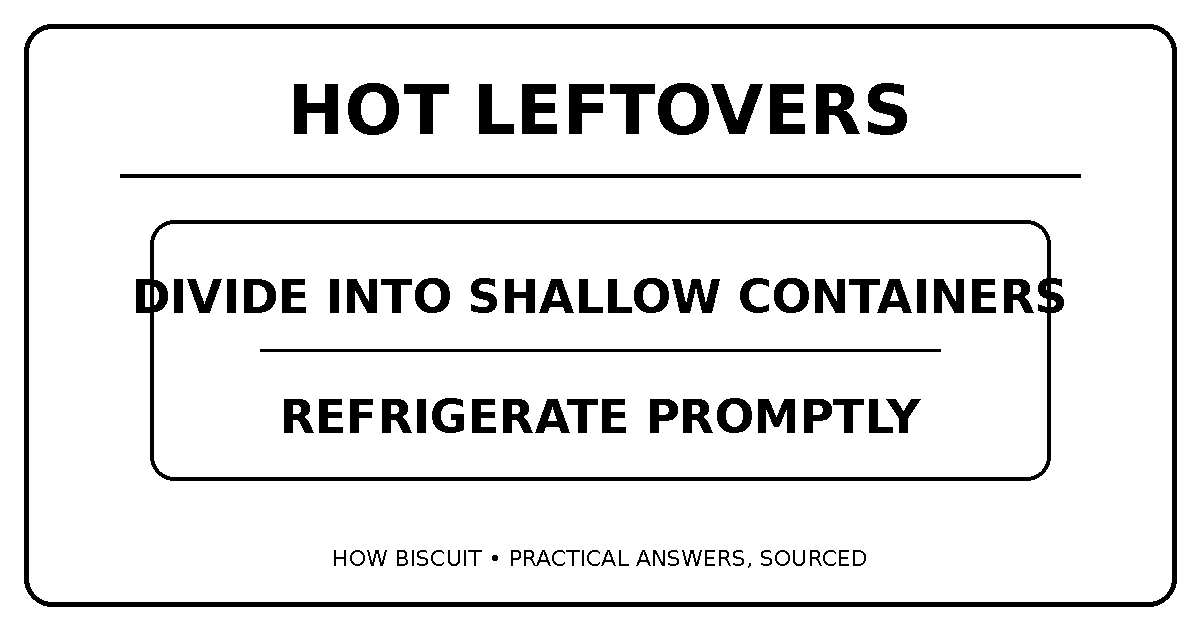
Yes. Hot food can be refrigerated directly. Divide large pots and large pieces into smaller portions or shallow containers, and refrigerate within two hours rather than waiting for everything to cool on the counter.
What to know
- Do not leave perishable cooked food out for hours just to protect the refrigerator.
- Shallow containers and smaller portions cool faster than one deep pot.
- Refrigerate leftovers within two hours, or within one hour when the surrounding temperature is above 90°F.
- Keep the refrigerator at 40°F or below and avoid packing it so tightly that cold air cannot circulate.
Hot food can be placed directly in the refrigerator. The larger safety problem is leaving perishable food at room temperature for a long time while waiting for it to become completely cool.
USDA says hot food may go directly into the refrigerator or be rapidly chilled in an ice or cold-water bath first. Large amounts should be divided into smaller portions and shallow containers so heat can escape more quickly. [1]
Why the “cool it on the counter first” rule causes trouble
Cooked food passing through roughly 40°F to 140°F is in the temperature range USDA calls the danger zone, where bacteria can grow rapidly. Leftovers should be refrigerated within two hours after cooking or after removal from hot holding. The limit is one hour when the surrounding temperature is above 90°F. [2]
A stockpot left on the counter for several hours may remain warm in the center while spending too much time in that range.
Why one giant pot is not ideal
A deep pot of soup, chili, stew, or sauce holds heat in its center. The outside may feel cool while the middle remains warm. Putting the whole pot in the refrigerator is better than abandoning it all night, but dividing it is safer and easier on the cooling process.
Use:
- shallow containers;
- smaller portions;
- loosely arranged containers with room for cold air to circulate;
- smaller pieces for large roasts or poultry.
USDA specifically recommends dividing large pots and cutting large foods into smaller portions before refrigeration. [1] [3]
Will hot food damage the refrigerator?
A normal household refrigerator is designed to remove heat, but a very large quantity of hot food can temporarily raise the surrounding temperature and make the appliance work harder. Portioning reduces that effect and helps the food cool faster.
Do not crowd every shelf with tightly packed hot containers. FDA advises leaving enough space for refrigerated air to circulate and keeping the appliance at 40°F or below. [4]
Should containers be covered immediately?
Protect food from contamination, but do not trap a huge mass of heat in one deep, tightly sealed container. Divide the food first. Use containers suitable for refrigeration and follow USDA guidance to wrap or cover leftovers for storage. [1]
For foods that produce a great deal of steam, a lid may be set loosely during initial cooling and secured once the food is cold, provided contamination is controlled. Household practices vary, and commercial kitchens follow more detailed cooling procedures.
A safe routine for soup or stew
- Finish cooking.
- Set aside the portion being served.
- Transfer the rest into several shallow containers.
- Use an ice-water bath for faster cooling if desired.
- Refrigerate promptly, no later than two hours after cooking.
- Once chilled, seal the containers securely.
- Use most cooked leftovers within three to four days or freeze them. [1]
Do not place a fragile glass container on a cold or wet surface while it is extremely hot unless the manufacturer says it can handle the temperature change. Food safety and thermal-shock safety are separate issues.
What if the food has already been out too long?
Refrigeration does not reverse unsafe time at room temperature. USDA advises discarding perishable food left out for more than two hours, or more than one hour above 90°F. [2]
Smell and appearance cannot reliably prove safety. Reheating also may not destroy every toxin that can be produced during improper storage.
What about a small plate of food?
A small serving cools quickly and can generally go into the refrigerator promptly in a covered container. The special concern is large, dense quantities that cool slowly.
Bottom line
Put hot leftovers in the refrigerator promptly. Divide big batches into shallow containers, leave room for air circulation, and keep the refrigerator at 40°F or below. Waiting hours for a large pot to cool on the counter solves the wrong problem and creates a food-safety one.
Limits and cautions
- Cooling time depends on food depth, container, refrigerator performance, and load.
- This article gives general U.S. food-safety guidance and does not replace instructions for commercial food service.
- Food that has already exceeded safe time limits should be discarded rather than rescued by refrigeration.
Source notes
- Leftovers and Food SafetyUSDA Food Safety and Inspection Service
- Danger Zone (40°F - 140°F)USDA Food Safety and Inspection Service
- Refrigeration and Food SafetyUSDA Food Safety and Inspection Service
- Are You Storing Food Safely?U.S. Food and Drug Administration
See something wrong or out of date? Report a correction.