
Power Outage Food Safety Chart: What to Keep and What to Throw Away
Use this chart after a household power outage.

Use this chart after a household power outage.
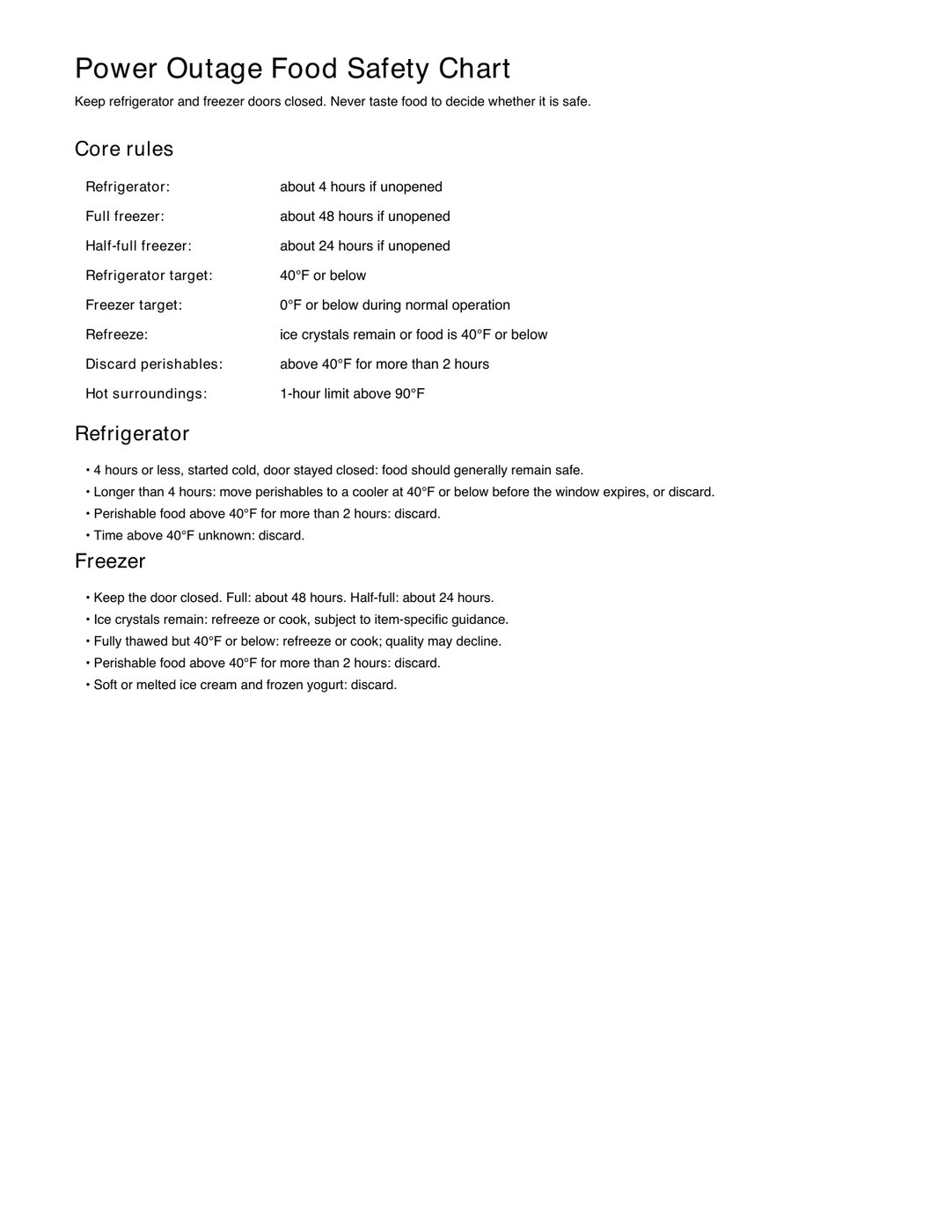
The basic rules are:
- Refrigerator: about 4 hours if unopened
- Full freezer: about 48 hours if unopened
- Half-full freezer: about 24 hours if unopened
- Refreeze frozen food that still has ice crystals or is 40°F or below
- Discard perishable food that was above 40°F for more than 2 hours
- Use a 1-hour limit for perishable food outside temperature control when the air temperature is above 90°F
- Never taste food to decide whether it is safe[1][2][3]
Download: Power Outage Food Safety Chart (PDF)
Printable PDF, no email address required.
Refrigerator decision chart
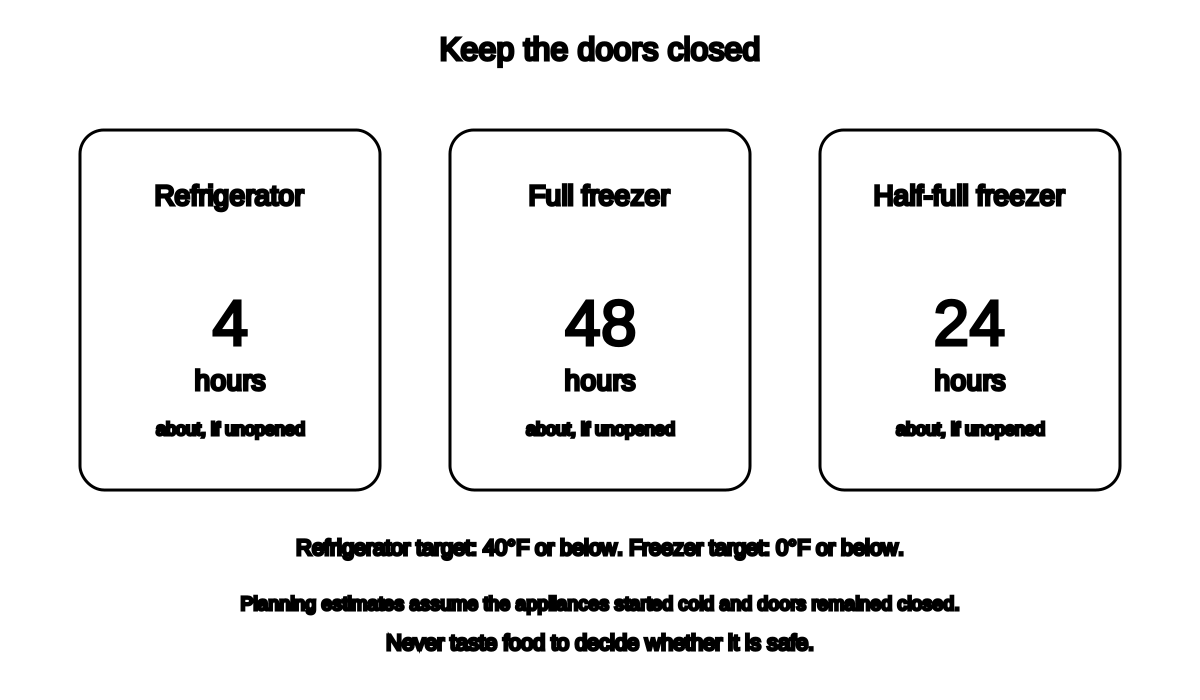
Approximate household planning limits when appliances start cold and doors remain closed.
| Situation | Decision |
|---|---|
| Power off 4 hours or less; door stayed closed | Refrigerated food should generally remain safe |
| Power off longer than 4 hours; perishables not moved to verified cold storage | Discard refrigerated perishables |
| Perishable food kept in cooler at 40°F or below | Keep while temperature remains verified |
| Perishable food above 40°F for more than 2 hours | Discard |
| Time above 40°F is unknown | Discard |
| Food smells normal | Smell does not prove safety |
| Food exposed to floodwater or raw-meat leakage | Use contamination guidance; discard when required |
Freezer decision chart
| Situation | Decision |
|---|---|
| Full freezer, unopened, outage under about 48 hours | Food may remain safely frozen; verify afterward |
| Half-full freezer, unopened, outage under about 24 hours | Food may remain safely frozen; verify afterward |
| Food still contains ice crystals | Refreeze or cook, subject to item-specific guidance |
| Food is fully thawed but 40°F or below | Refreeze or cook; quality may decline |
| Perishable food above 40°F for more than 2 hours | Discard |
| Soft or melted ice cream or frozen yogurt | Discard |
| Raw-meat juices contaminated another item | Discard contaminated item |
| Time and temperature unknown | Discard |
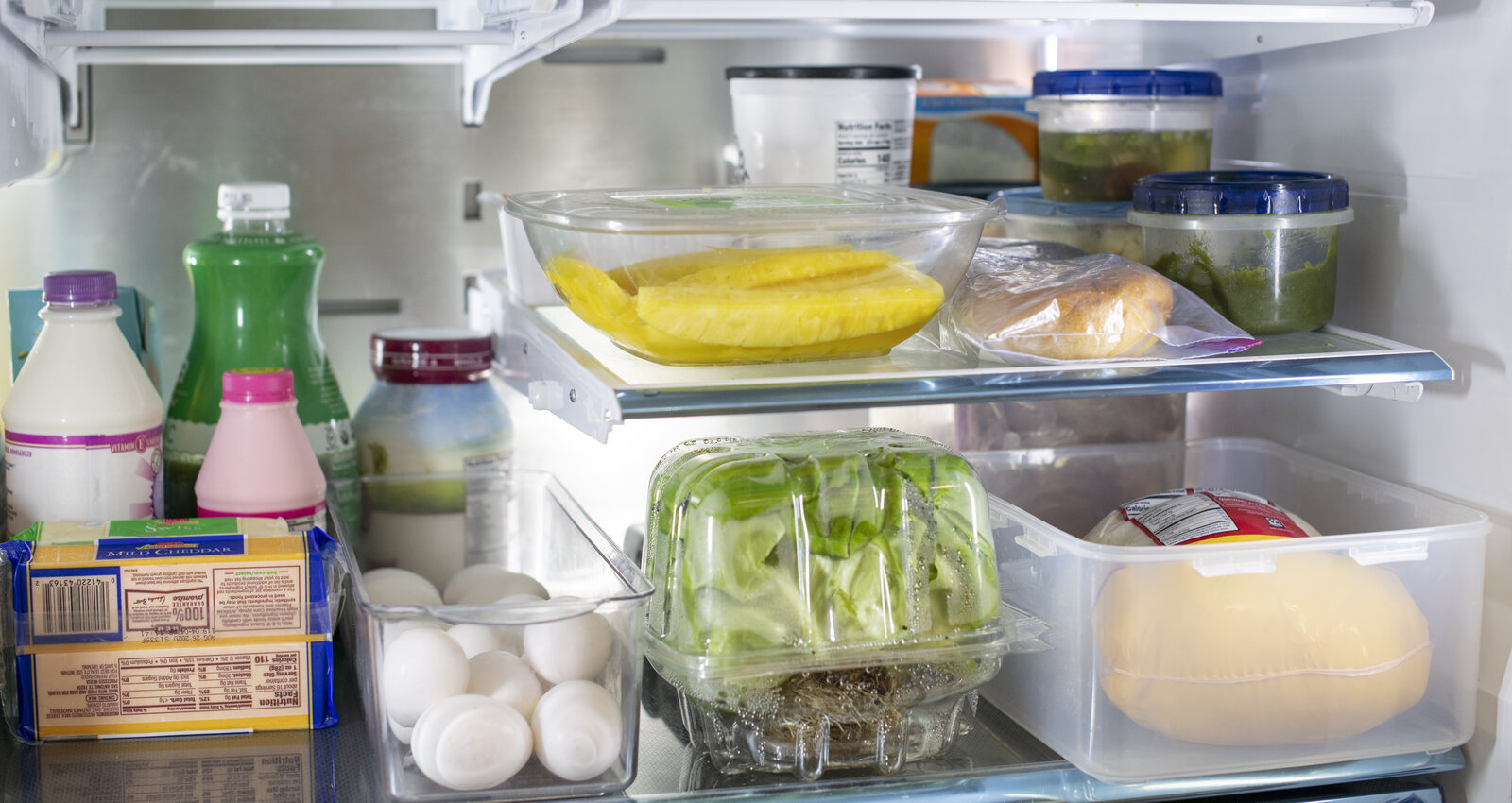
Common refrigerated foods
.jpg)
Discard after unsafe warming
- Meat
- Poultry
- Seafood
- Milk
- Eggs
- Soft cheese
- Deli meat
- Leftovers
- Pizza
- Cooked rice and pasta
- Cooked vegetables
- Cut melon
- Packaged cut greens
- Cream-filled pastries
- Custard or cream pies
May remain safe under USDA guidance
- Hard cheese
- Processed cheese
- Butter and margarine
- Whole fruits and vegetables
- Bread and rolls
- Fruit pies
- Peanut butter
- Jelly
- Mustard
- Ketchup
- Pickles
- Relish
- Flour and nuts
Use the official item-specific chart for foods not listed here.
During the outage
- Keep doors closed.
- Write down the outage start time.
- Prepare a cooler if the outage will exceed four hours.
- Add ice or gel packs.
- Keep cooler food at 40°F or below.
- Group frozen food together.
- Use dry ice only with proper gloves, ventilation, and handling.
- Do not put food outside in snow.
- Do not taste questionable food.
When power returns
- Check the appliance thermometer.
- Check the most exposed freezer packages.
- Look for ice crystals.
- Measure individual food when needed.
- Separate leaking raw foods.
- Keep, refreeze, cook, or discard each item.
- Clean contaminated surfaces.
- Record what was discarded for insurance or assistance documentation when relevant.
Refrigerator and freezer thermometer targets
- Refrigerator: 40°F or below
- Freezer: 0°F or below during normal operation
- Outage refreezing threshold: 40°F or below, or ice crystals remain
Keep one appliance thermometer in each compartment.
Important limitations
The time estimates assume:
- The appliance was cold before the outage
- Doors stayed closed
- The appliance was functioning normally
- Food was not already left out
- No floodwater or chemical contamination occurred
This chart does not override:
- Product labels
- A public-health recall
- Flood contamination guidance
- Instructions for medically necessary foods or medications
- Advice from a local health department during a specific emergency
Help
For food-safety questions, FoodSafety.gov directs consumers to the USDA Meat and Poultry Hotline at 1-888-674-6854 and Ask USDA.[1]
Seek medical advice if someone develops symptoms of foodborne illness, especially if they are pregnant, older, very young, immunocompromised, or seriously ill.
Related power-outage food-safety guides
- Use the refrigerator outage timeline
- Use the freezer outage timeline
- Check which foods to throw away
- Decide whether thawed food can be refrozen
- Choose and place appliance thermometers
Source notes
- Avoid Foodborne Illness During Temporary Power OutagesFoodSafety.gov
- Keeping Food Safe During an EmergencyUSDA Food Safety and Inspection Service
- Food and Water Safety During Power Outages and FloodsU.S. Food and Drug Administration
- Discarding Food After a Power OutageCenters for Disease Control and Prevention
- Appliance ThermometersUSDA Food Safety and Inspection Service
See something wrong or out of date? Report a correction.