
How Much Does an Electric Dryer Cost Per Load?
Use model-specific annual kWh, ENERGY STAR efficiency data, or measured kWh from appropriate equipment. A standardized example at the ENERGY STAR minimum CEF of 3.93 uses about 2.15 kWh per test load, or about 40 cents at 18.44 cents per kWh.
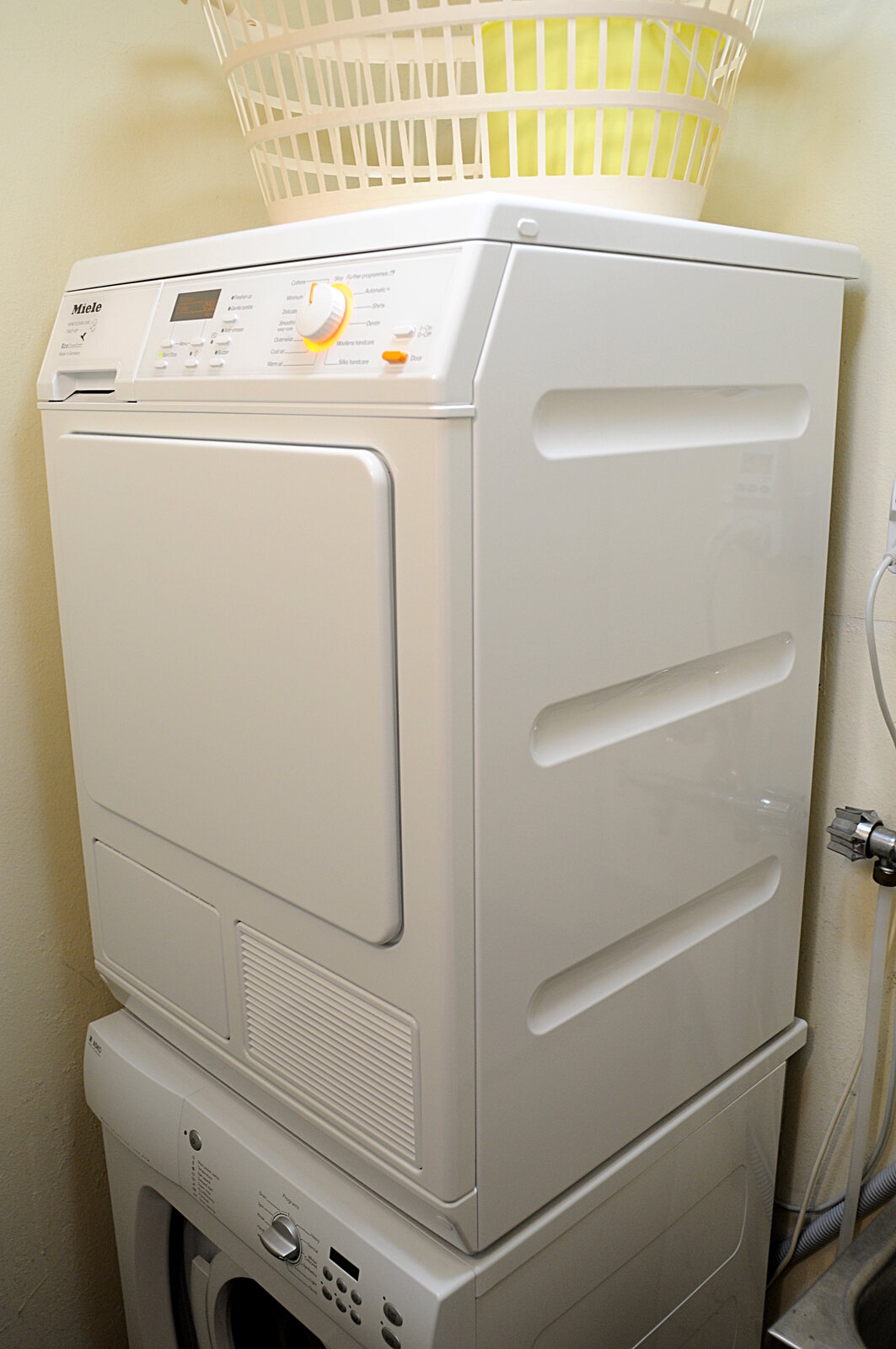

Electric-dryer cost per load depends on:
- Dryer efficiency
- Load size
- Remaining moisture from the washer
- Cycle temperature
- Sensor performance
- Vent condition
- Runtime
- Electricity rate
There is no useful universal “dryer wattage” that predicts every load.
Quick answer: Use model-specific annual kWh, ENERGY STAR efficiency data, or measured kWh from appropriate equipment. A standardized example at the ENERGY STAR minimum CEF of 3.93 uses about 2.15 kWh per test load, or about 40 cents at 18.44 cents per kWh.
ENERGY STAR’s dryer efficiency metric
ENERGY STAR uses Combined Energy Factor, or CEF:
CEF =
\frac(test load in pounds)
(operating and standby energy in kWh)
Higher CEF means greater efficiency.
For standard dryers, the test load is 8.45 pounds. The current ENERGY STAR minimum CEF for standard electric vented or ventless dryers is 3.93 pounds per kWh.[1]
Rearrange:
kWh per test load =
(8.45) / (CEF)
Standardized minimum-efficiency example
At CEF 3.93:
8.45 ÷ 3.93 = 2.15 kWh per test loadAt $0.1844 per kWh:
2.15 × $0.1844 = $0.40About 40 cents per standardized test load.
This is not a universal household load. Actual laundry moisture, load size, venting, cycle, and model change energy use.
Higher-efficiency example
A hypothetical heat-pump dryer with CEF 9.3 would use:
8.45 ÷ 9.3 = 0.91 kWh per test loadAt $0.1844 per kWh:
0.91 × $0.1844 = $0.17About 17 cents per standardized test load.
ENERGY STAR Product Finder currently lists certified heat-pump models with CEF values in that range, but this example is not a recommendation for a particular product.[2]
Annual kWh method
ENERGY STAR Product Finder reports estimated annual energy use for certified dryers.
Use:
Annual cost =
annual kWh
×
rate
Then divide by your own annual loads:
average cost per household load =
\frac(annual cost)
(your annual loads)
Do not divide by a guessed 365 unless you actually dry one load every day.
Why nameplate watts are misleading
A standard electric dryer may have:
- Heating element
- Motor
- Blower
- Controls
- Drum light
- Standby power
The heater cycles. Sensor cycles may stop early. Low heat may run longer. A 45-minute display does not mean maximum heating-element wattage for 45 minutes.
A nameplate full-power calculation can provide a ceiling-style estimate, not actual cost.
Gas dryers
This article is for electric dryers.
A gas dryer uses:
- Natural gas or propane for heat
- Electricity for motor, controls, and ignition
Electricity-only calculations omit fuel cost.
Do not compare a gas dryer’s electric kWh with an electric dryer’s total cost.
Washer spin speed matters
A washer that removes more water leaves less work for the dryer.
ENERGY STAR notes that efficient washers can reduce remaining moisture, lowering dryer energy use.[3]
Use the highest appropriate spin speed for the fabric and washer instructions.
Do not damage delicate items merely to save a few cents.
Load size
Drying too large a load can increase drying time because clothes need room to tumble and air must circulate.[3]
Very small loads can also be inefficient per garment.
Use a load that:
- Matches dryer capacity
- Tumbles freely
- Separates heavy and light fabrics when appropriate
- Does not block airflow
Sensor dry
Moisture sensors can stop the cycle when clothes are dry, reducing over-drying.
Keep sensors clean according to the manual.
Timed dry can be useful for some loads, but guessing too long wastes energy and can damage fabric.
Clean the lint filter
ENERGY STAR recommends cleaning the lint filter after every load to improve airflow and efficiency. It also identifies lint-filter cleaning as an important safety measure.[3]
Dryer sheets can leave film on some filters. Follow the manufacturer cleaning guidance.
Do not operate the dryer without the filter.
Vent condition
A restricted vent can increase drying time and create a hazard.
Check:
- Crushed duct
- Excessive bends
- Lint buildup
- Exterior flap
- Incorrect material
- Long vent run
Follow the dryer manual and local code. Use qualified service when the vent is inaccessible.
Line drying and partial drying
Air drying eliminates dryer electricity for those items.
A hybrid approach can:
- Partially dry in the machine
- Finish on a rack or line
- Use low heat
- Remove lighter items early
Follow fabric-care labels. Do not dry indoors in a way that creates moisture, mold, or building damage.
Time-of-use rates
A dryer can be shifted to a lower-rate period when:
- Utility rate changes by time
- Appliance use is permitted
- Household can monitor it
- Noise rules allow it
Do not operate a dryer while sleeping or away when the manufacturer, fire-safety guidance, lease, or household safety plan says otherwise.
Frequently asked questions
How much does a dryer cost for one hour?
Hourly cost is less useful than per-load kWh because the heater cycles. Measure or use standardized energy data.
Does low heat cost less?
It may draw less power but run longer. The total kWh is model- and load-specific.
Is a heat-pump dryer cheaper to run?
Certified heat-pump models can have much higher CEF and lower annual kWh, but purchase price, cycle time, installation, capacity, maintenance, and climate matter.
Does cleaning the lint filter save electricity?
It improves airflow and can reduce unnecessary drying time. ENERGY STAR recommends cleaning after every load.[3]
Can I use a plug-in watt meter?
Most standard electric dryers are 240-volt or hardwired and are not suitable for ordinary plug-in meters.
Related appliance and household-energy guides
- Calculate any appliance’s electricity cost
- Diagnose a high summer electric bill
- Use the printable home-energy check
Source notes
- Clothes Dryers Key Product CriteriaENERGY STAR
- ENERGY STAR Certified Clothes DryersENERGY STAR
- Clothes DryersENERGY STAR
- Smart AppliancesENERGY STAR
See something wrong or out of date? Report a correction.