
How to Calculate What an Appliance Costs to Run
Use annual kWh from an EnergyGuide label for major appliances when available. Use measured kWh for a compatible plug-in appliance. Use watts multiplied by time only when you understand that the result is a full-power estimate.

The basic appliance-cost formula is:
Cost =
energy used in kWh
×
electricity price per kWh
The difficult part is finding the appliance’s actual energy use. A refrigerator cycles on and off. A dishwasher changes power during washing, water heating, and drying. An oven cycles its heating elements. A clothes dryer changes heat and airflow during the load.
For those appliances, the largest wattage printed on a label is not the same thing as average electricity use.
Quick answer: Use annual kWh from an EnergyGuide label for major appliances when available. Use measured kWh for a compatible plug-in appliance. Use watts multiplied by time only when you understand that the result is a full-power estimate.
Start with your electricity price
Find the electricity charge on your utility bill.
Electricity prices are commonly shown in cents per kilowatt-hour:
- 15 cents per kWh =
$0.15 - 18.44 cents per kWh =
$0.1844 - 25 cents per kWh =
$0.25
The May 2026 U.S. residential average was 18.44 cents per kWh, according to the U.S. Energy Information Administration.[1]
That national number is useful for a dated example. Your calculation should use your own utility rate.
Which rate should you use?
Your bill may include:
- Energy or supply charge
- Delivery charge based on kWh
- Fuel or power-cost adjustment
- Time-of-use rates
- Tiered rates
- Taxes
- Fixed monthly customer charge
For the cost of additional appliance use, use the charges that change with each additional kWh.
A fixed customer charge is paid even if the appliance is unplugged, so replacing an appliance does not eliminate that fee.
If the rate changes by time of day, calculate each period separately.
Method 1: Use annual kWh
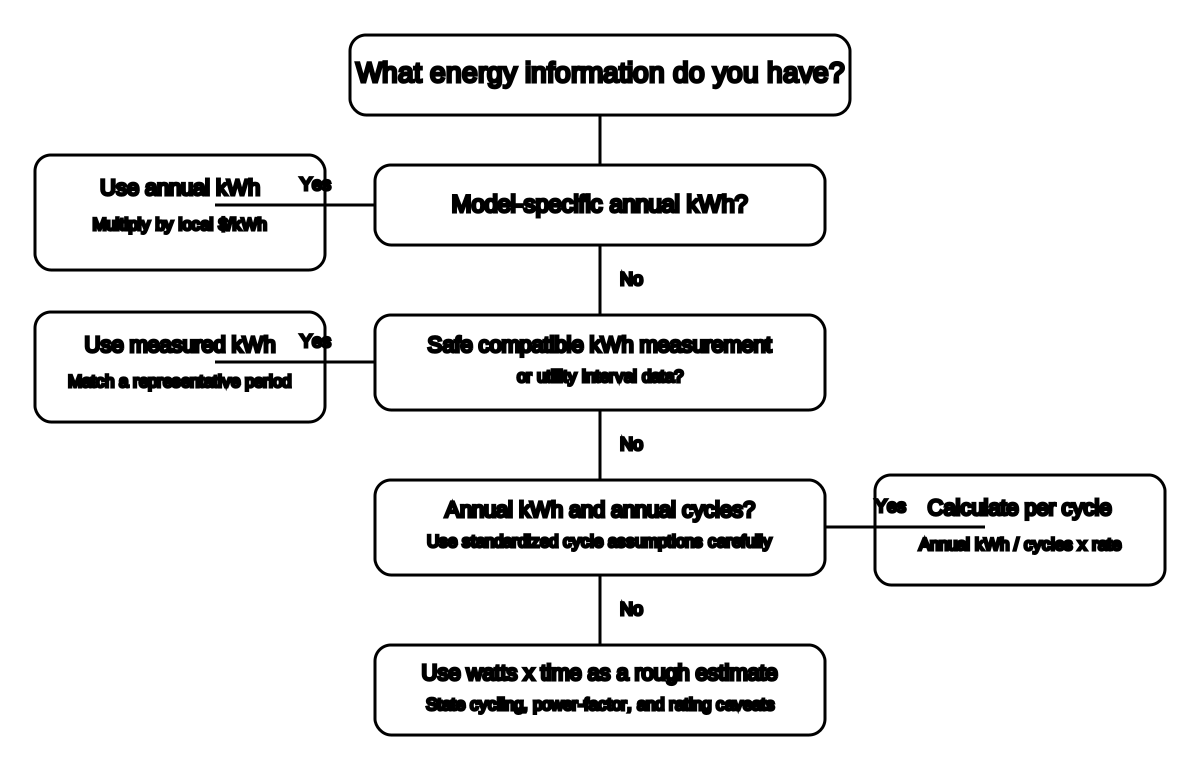
Choose model-specific annual kWh first, then safe measured kWh, documented per-cycle data, or a clearly labeled watts-and-time estimate.
This is usually the best method for:
- Refrigerators
- Freezers
- Dishwashers
- Clothes washers
- Other appliances with standardized annual-energy data
The yellow EnergyGuide label shows annual energy use for covered products and lets shoppers compare similar models. The estimated operating cost is based on standardized use and a national energy price, so FTC advises that your actual cost will depend on your use and local rate.[2]
Use:
Annual cost =
annual kWh
×
your rate
Example
Suppose a refrigerator’s label shows 400 kWh per year.
At $0.1844 per kWh:
400 × $0.1844 = $73.76Estimated annual electricity cost: $73.76
Estimated monthly average:
$73.76 ÷ 12 = $6.15The refrigerator does not use exactly $6.15 every month. Room temperature, door openings, defrost cycles, loading, and other conditions change consumption.
Method 2: Use measured kWh
A compatible plug-in electricity meter can measure cumulative kWh for many ordinary 120-volt appliances.
This method is useful for:
- Air fryers
- Toaster ovens
- Dehumidifiers
- Televisions
- Computers
- Some compact refrigerators
- Other plug-in devices within the meter’s rating
Procedure:
- Confirm the meter’s voltage, amperage, and wattage limits.
- Confirm the appliance manual permits ordinary plug-in connection.
- Reset the meter.
- Run the appliance through a representative period or cycle.
- Record cumulative kWh.
- Multiply by your local rate.
If a meter records 1.35 kWh over three dishwasher-like cycles of a compatible countertop appliance:
1.35 ÷ 3 = 0.45 kWh per cycleAt $0.1844 per kWh:
0.45 × $0.1844 = $0.083About 8 cents per cycle for electricity.
Do not use an ordinary plug-in meter on:
- Hardwired appliances
- Standard 240-volt electric dryers
- Electric ranges or wall ovens
- Equipment exceeding the meter’s rating
- Damaged cords or outlets
- Appliances whose instructions prohibit adapters or intermediate devices
Do not improvise a 240-volt measurement setup. Use model data, utility interval data, or appropriately installed monitoring equipment.
Method 3: Use watts and time
Use this when:
- Watts are known
- Runtime is known
- The appliance runs at roughly that power
- You clearly label the result as an estimate
First convert watts to kilowatts:
kW = \frac(watts)(1,000)Then:
kWh =
kW
×
hours
Finally:
Cost =
kWh
×
rate
Example
A hypothetical 1,000-watt appliance runs at full power for two hours:
1,000 ÷ 1,000 = 1.0 kW1.0 × 2 = 2.0 kWh2.0 × $0.1844 = $0.3688Estimated cost: 37 cents
If the appliance cycles off for part of the two hours, actual energy use will be lower than this full-power estimate.
Method 4: Calculate cost per cycle from annual data
For an appliance with annual kWh and a stated annual test-cycle assumption:
kWh per test cycle =
(annual kWh) / (annual test cycles)
Then:
cost per test cycle =
kWh per test cycle
×
rate
ENERGY STAR states that the current dishwasher test procedure uses an average of 215 cycles per year.[3]
A standard-size certified dishwasher at the 240 kWh-per-year ENERGY STAR limit would have a standardized average of:
240 ÷ 215 = 1.12 kWh per test cycleAt $0.1844 per kWh:
1.12 × $0.1844 \approx $0.21That is a standardized electricity example, not a promise for every cycle.
Watts, kilowatts, and kilowatt-hours
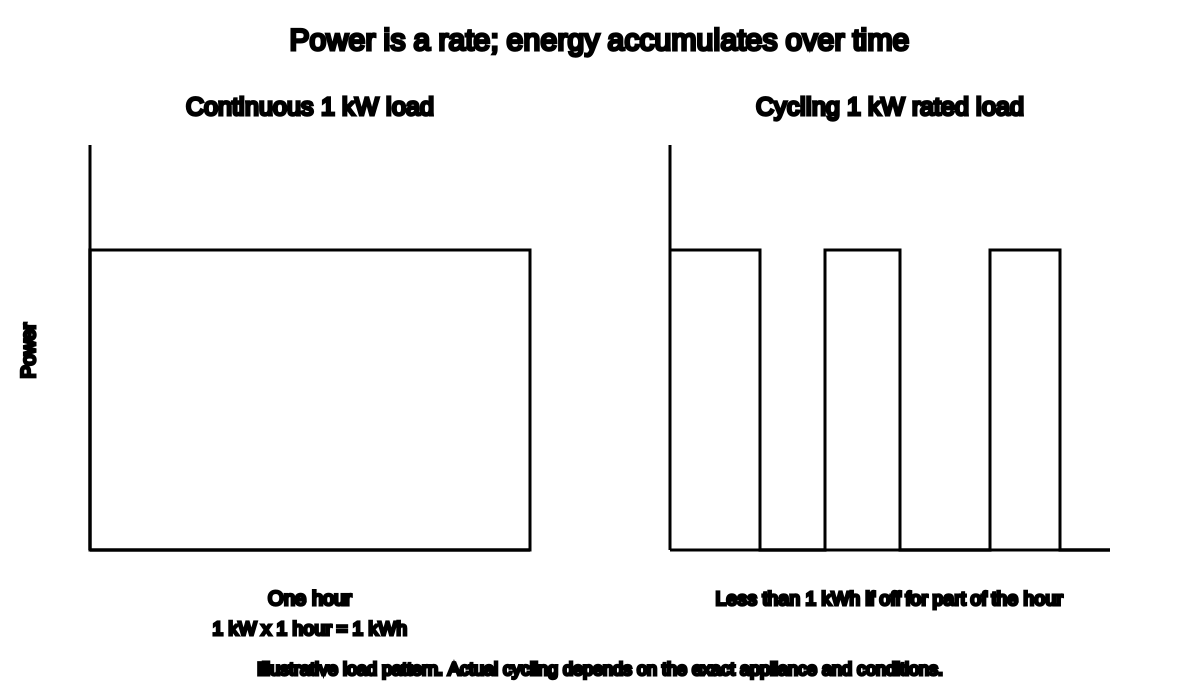
Illustrative load pattern. Actual cycling depends on the exact appliance and conditions.
These terms are related but not interchangeable.
- Watt: instantaneous power
- Kilowatt: 1,000 watts
- Kilowatt-hour: energy equal to one kilowatt used for one hour
A 2,000-watt appliance has a power rating of 2 kW. If it runs at that power for 30 minutes, it uses:
2 × 0.5 = 1 kWhPower is the rate. Energy is the amount accumulated over time.
Why the nameplate can mislead you
A nameplate may show:
- Rated input
- Maximum input
- Heating-element power
- Motor power
- Voltage and amperage
- Circuit requirements
- Total connected load
These numbers serve electrical and safety purposes. They may not describe average operation.
Examples:
- A refrigerator compressor cycles.
- An oven element turns on and off around the set temperature.
- A dishwasher heater operates during only part of the cycle.
- A dryer changes heat during sensor-controlled operation.
- A range’s total connected load assumes combinations of elements, not one ordinary meal.
Do not multiply a circuit-breaker rating by voltage and call that appliance energy use. The breaker protects the circuit; it is not an electricity meter.
What if the label lists volts and amps but not watts?
A rough apparent-power estimate is:
volt-amperes =
volts
×
amps
For a simple resistance heater, volt-amperes and watts may be close.
For motors, electronic controls, compressors, and other alternating-current loads, actual watts may differ because of power factor, startup current, and cycling.
Treat volts multiplied by amps as a rough upper-style estimate unless the product documentation explains the rating.
Standby power
Some appliances draw power while waiting:
- Clocks
- Displays
- Network connections
- Remote controls
- Sensors
- Control boards
For major appliances, standardized annual energy figures may include specified low-power modes.
For a plug-in appliance, measure a representative 24-hour period if standby matters.
A device drawing 3 watts continuously would use:
0.003 × 24 × 365 = 26.28 kWh per yearAt $0.1844 per kWh:
26.28 × $0.1844 = $4.85 per yearDo not unplug safety-critical, medical, network, refrigeration, or clock-dependent equipment merely to eliminate trivial standby use.
Time-of-use rates
If your utility charges different rates:
Total cost =
(off-peak kWh × off-peak rate)
+
(peak kWh × peak rate)
A dishwasher or dryer may cost less to run off-peak, but only if:
- The utility actually uses time-varying rates
- The appliance can run safely unattended under its instructions
- Noise or building rules permit it
- The delay function is used correctly
A reliable calculation order
Use the strongest available method:
- Annual kWh from a model-specific official label
- Model-specific certified data
- Measured kWh from a safe compatible meter
- Utility interval-data comparison
- Watts multiplied by time
- Volts multiplied by amps only as a rough estimate
Do not start with a generic internet wattage table when model-specific data exists.
Download the worksheet
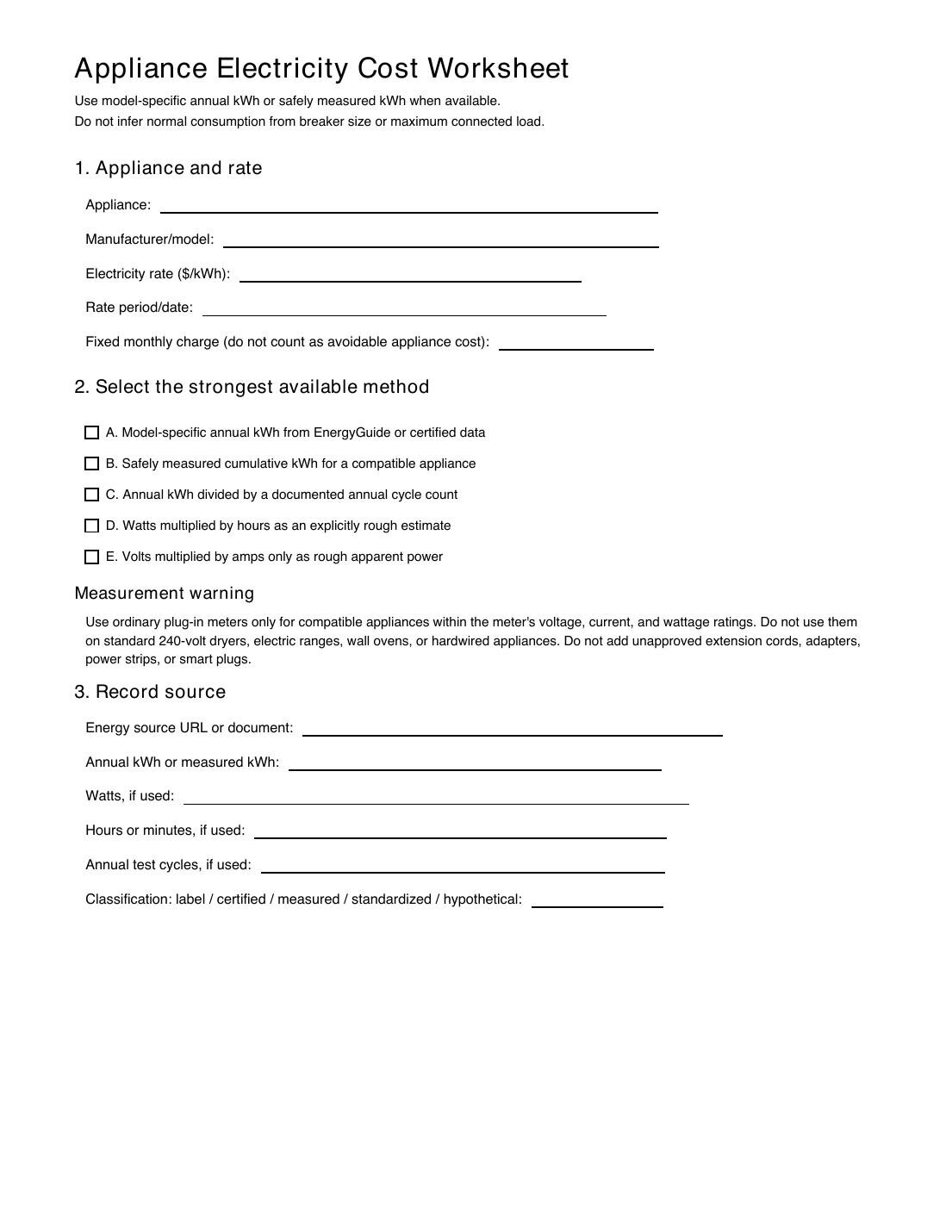
The companion Appliance Electricity Cost Worksheet includes:
- Annual-kWh method
- Watts-and-time method
- Per-cycle method
- Time-of-use method
- Monthly and annual projections
- Comparison fields for two appliances
It downloads directly as a PDF without an email gate.
Frequently asked questions
Is the EnergyGuide estimated cost my actual cost?
No. FTC says it uses standardized assumptions and a national energy price. Use the annual kWh from the label with your own rate.
Can I use a smart plug to measure any appliance?
No. Use only equipment rated for the appliance, voltage, current, and connection type. Do not use ordinary smart plugs on 240-volt or hardwired appliances.
Does a 1,500-watt appliance always use 1.5 kWh per hour?
Only if it draws 1,500 watts continuously for the entire hour.
Should I include fixed charges?
Not when calculating the cost caused by one additional appliance. Fixed charges remain even if usage changes.
Is breaker size a good estimate?
No. Breaker size describes circuit protection, not normal appliance consumption.
Related appliance and household-energy guides
- Estimate refrigerator electricity cost
- Calculate dishwasher cost per load
- Calculate electric-dryer cost per load
- Estimate electric-oven cost per hour
- Compare air-fryer and oven electricity cost
- Diagnose a high summer electric bill
- Use the printable home-energy check
- Compare household energy benchmarks
Source notes
- Electric Power Monthly: Sales, Revenue, and Average Price of Electricity to Ultimate Customers for May 2026U.S. Energy Information Administration
- How To Use the EnergyGuide Label To Shop for Home AppliancesFederal Trade Commission
- Dishwashers Key Product CriteriaENERGY STAR
- Full Text GlossaryU.S. Department of Energy
- Energy and Water Use Labeling for Consumer Products Under the Energy Policy and Conservation ActFederal Trade Commission
See something wrong or out of date? Report a correction.