
How Much Does an Electric Oven Cost Per Hour?
A hypothetical 3,000-watt oven would cost about 55 cents per full-power hour at 18.44 cents per kWh. If it ran at full power for 45 minutes, the estimate would be about 41 cents. Actual cost is usually different because of preheat, cycling, oven size, temperature, and cooking time.
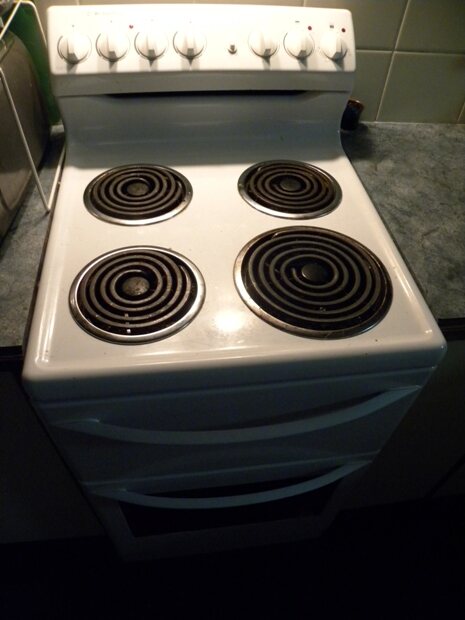

An electric oven’s full-power hourly cost is:
Hourly cost =
\frac(watts)(1,000)
×
electricity rate
But an oven normally cycles its heating elements. It does not necessarily draw the full rated heating power for every minute shown on the clock.
Quick answer: A hypothetical 3,000-watt oven would cost about 55 cents per full-power hour at 18.44 cents per kWh. If it ran at full power for 45 minutes, the estimate would be about 41 cents. Actual cost is usually different because of preheat, cycling, oven size, temperature, and cooking time.
Full-power example
Suppose the manual lists 3,000 watts of active heating power.
Convert to kilowatts:
3,000 ÷ 1,000 = 3 kWAt $0.1844 per kWh:
3 × $0.1844 = $0.5532About 55 cents per full-power hour.
For 45 minutes:
45 ÷ 60 = 0.75 hour3 × 0.75 = 2.25 kWh2.25 × $0.1844 = $0.4149About 41 cents.
This is a deliberately simple full-power estimate. A thermostat-controlled oven cycles.
Find the oven’s power
Use:
- Owner’s manual
- Model-specific specification sheet
- Rating plate
- Manufacturer technical documentation
Do not use:
- Breaker size as consumption
- Total range connected load as oven-only power
- A generic internet wattage
- Another model’s specification
A range may list the combined maximum load for several cooktop elements and oven components. Ordinary use rarely activates every element at maximum simultaneously.
Preheat energy
Preheating uses substantial active heating.
Cost depends on:
- Starting temperature
- Set temperature
- Oven size
- Insulation
- Heating-element power
- Room temperature
- Door openings
- Convection mode
- Appliance condition
If a recipe does not require preheating, skipping it may save energy. Follow food-safety and recipe instructions.
Do not put food into a cold oven when safe cooking depends on a preheated temperature.
Thermostat cycling
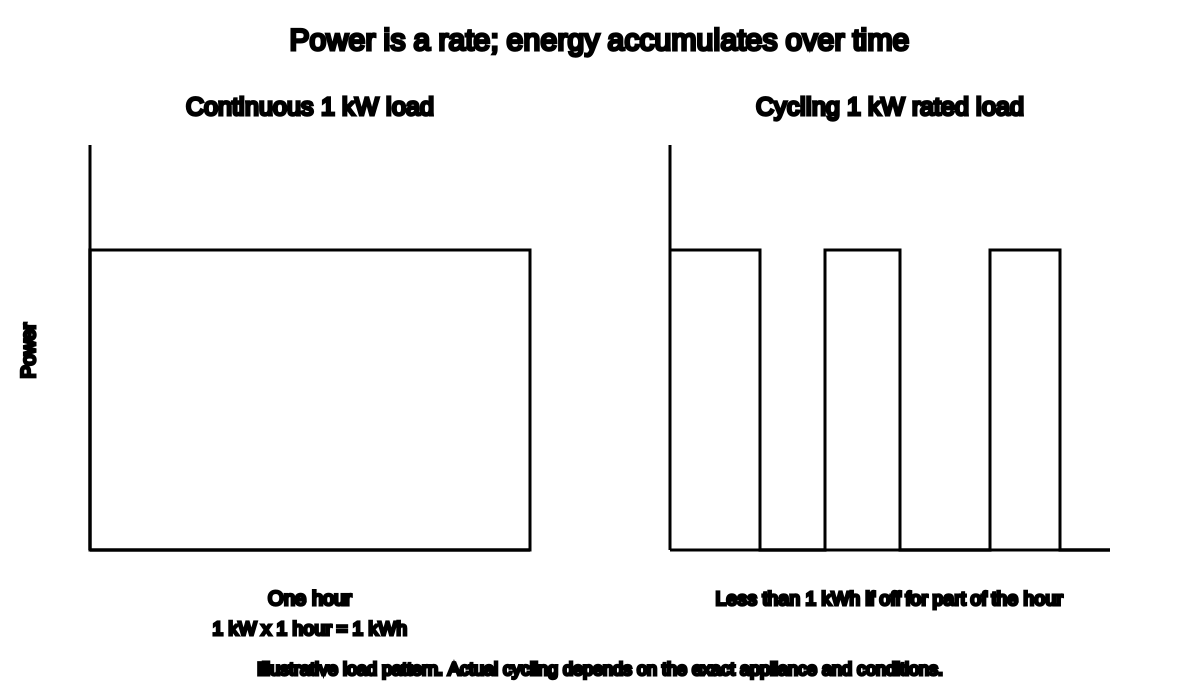
Illustrative load pattern. Actual cycling depends on the exact appliance and conditions.
After reaching temperature, the oven turns elements on and off to maintain the setpoint.
The full-power formula overstates energy if it assumes uninterrupted heating.
A better estimate uses:
- Model energy data
- Utility interval data
- Properly installed whole-home monitoring
- A carefully controlled comparison of similar cooking events
Ordinary plug-in meters are not for hardwired or 240-volt ovens.
Convection mode
Convection uses a fan to move hot air.
It may permit:
- Lower temperature
- Shorter cooking time
- More even cooking
The actual energy effect depends on:
- Food
- Recipe
- Oven
- Fan power
- Temperature change
- Cooking duration
Use the manufacturer’s conversion guidance.
Self-cleaning cycle
High-temperature self-cleaning uses substantial energy and heat.
Use only as the manufacturer directs.
Do not run it merely to collect an electricity-cost experiment. Ventilation, pets, cookware removal, racks, smoke alarms, and appliance instructions matter.
A steam-clean or manual-clean option may use less energy for light soil, but follow the manual.
Standby electricity
An electric range or oven may use standby power for:
- Clock
- Display
- Wi-Fi
- Controls
- Remote features
ENERGY STAR’s residential electric cooking criteria include low-power-mode measurements for eligible products.[1]
Do not shut off power at the breaker between meals merely to eliminate clock use unless the manufacturer and household safety plan permit it. Repeated power cycling can erase settings and create inconvenience disproportionate to the savings.
ENERGY STAR and electric cooking
ENERGY STAR certification now covers eligible residential electric cooktops and ranges, including induction, radiant, and coil products. Standalone ovens are not eligible under the current program.[1][2]
The current criteria use an annual assumption of 418 cooking events averaging 31 minutes each.[1]
That test basis is useful for comparing eligible products. It does not tell you the cost of one specific roast, pizza, or tray of cookies.
Use the smallest appropriate appliance
For a small food quantity, a:
- Toaster oven
- Air fryer
- Microwave
- Electric pressure cooker
may use less electricity because it heats a smaller cavity or cooks faster.
That is not universal. Capacity, batches, wattage, preheat, food quality, and safety matter.
See Air Fryer vs. Oven Electricity Cost for a direct comparison method.
Avoid unnecessary door opening
Opening the door releases heat and can lengthen cooking.
Use:
- Oven light
- Window
- Timer
- Food thermometer when appropriate
Do not compromise safe food temperature or burn food to avoid opening the door once.
Cook multiple items together
When temperatures and food-safety requirements match, cooking multiple items during one preheat can reduce energy per item.
Do not overcrowd, block airflow, mix allergen-sensitive foods carelessly, or combine dishes with incompatible safe-cooking requirements.
Frequently asked questions
Does a 3,000-watt oven cost 55 cents every hour?
Only if it draws 3,000 watts continuously for the full hour at an 18.44-cent rate.
Does an oven use full power while maintaining temperature?
Usually not continuously. Heating elements cycle.
Is convection cheaper?
It can reduce time or temperature for suitable recipes, but the actual energy difference is model- and food-specific.
Is preheating always necessary?
No, but some recipes and food-safety processes require it.
Can I measure an oven with a plug-in meter?
Do not use ordinary 120-volt plug-in meters on a hardwired or 240-volt oven.
Related appliance and household-energy guides
- Calculate any appliance’s electricity cost
- Compare air-fryer and oven electricity cost
- Calculate dishwasher cost per load
Source notes
- Residential Electric Cooking Products Key Product CriteriaENERGY STAR
- Electric Cooking ProductsENERGY STAR
- Full Text GlossaryU.S. Department of Energy
- Electric Power Monthly: Sales, Revenue, and Average Price of Electricity to Ultimate Customers for May 2026U.S. Energy Information Administration
See something wrong or out of date? Report a correction.