
What Temperature Should a Refrigerator Be?
Keep the refrigerator at 40°F or below and the freezer at 0°F. A practical refrigerator target is about 37°F, but verify the actual compartment temperature with an appliance thermometer because the control number may not equal degrees.
What to know
- Keep the refrigerator at 40°F or below.
- Keep the freezer at 0°F.
- Use an appliance thermometer to verify the actual temperature.
- Avoid overpacking and respond promptly when food has been too warm.
Keep the refrigerator at 40°F or below and the freezer at 0°F. A setting near 37°F is a useful operating target for many refrigerators because it leaves some margin below the 40°F limit, but the number on a control dial is not necessarily degrees. Verify the actual temperature with a refrigerator/freezer appliance thermometer. The FDA gives the 40°F and 0°F limits and specifically recommends appliance thermometers. [1]
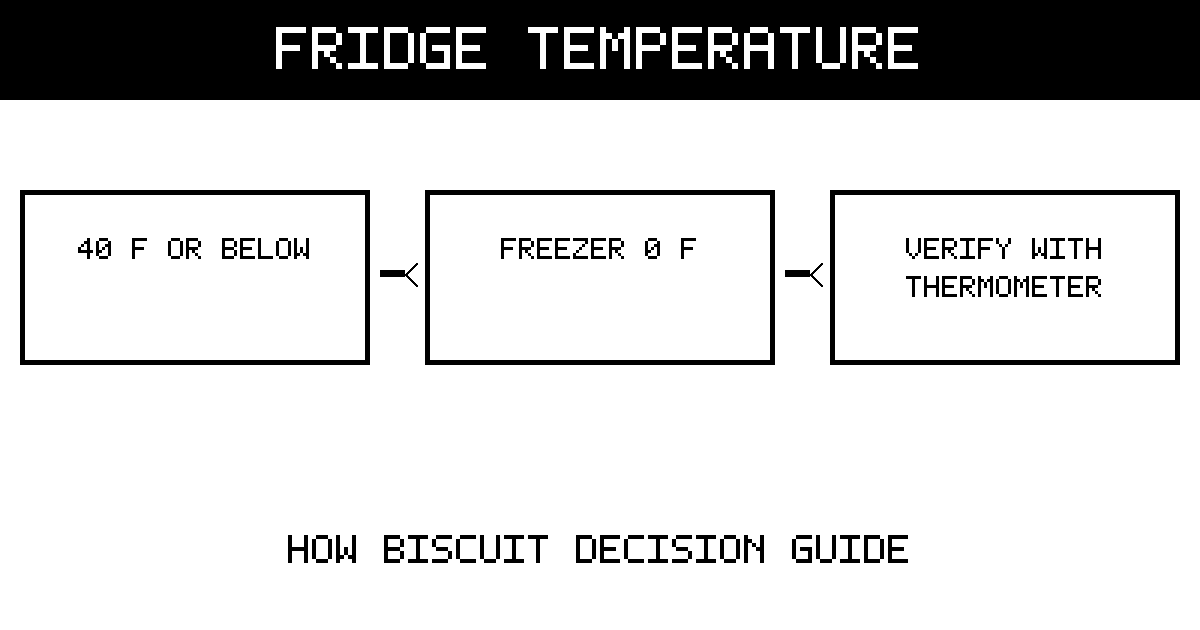
The diagram shows the target and the verification step. The thermometer reading matters more than whether the control says 3, 5, “cold,” or “recommended.”
How to measure the temperature
Use a thermometer designed for refrigerators and freezers. Put it in the location recommended by the thermometer and refrigerator makers, away from direct contact with a cooling vent or a recently added hot or frozen item. Allow enough time for the compartment and instrument to stabilize before judging a change.
For a fuller picture, check more than one location over time. Door shelves commonly experience larger temperature swings because the door opens and because they sit farther from the cold-air source. The coldest area can vary with the model, airflow pattern, and loading.
Record the reading before changing the control. Make one small adjustment, wait the manufacturer-specified stabilization period—often many hours—and check again. Rapid repeated adjustments make cause and effect difficult to see.
Why 40°F is the limit
Cold storage slows the growth of many microorganisms but does not sterilize food. The USDA lists refrigeration at 40°F or below as one of its basic food-safety controls. [2] Perishable food still has storage-time limits even at the correct temperature.
A freezer at 0°F keeps food frozen and preserves safety while continuously frozen, though quality can decline over time. Soft ice cream or a package that remains partly thawed can be a clue that the freezer is too warm, but a thermometer is the objective check.
Help the refrigerator hold temperature
- Do not overpack it. Cold air needs space to circulate. The FDA warns that overpacking can prevent adequate airflow. [1]
- Keep the door closed as much as practical. Group tasks and repair a damaged gasket rather than repeatedly checking by touch.
- Cover and arrange food safely. Keep raw animal foods contained so they cannot drip onto ready-to-eat foods.
- Cool leftovers promptly in shallow containers. Do not leave food on the counter just to protect the refrigerator from warmth.
- Keep vents clear. Follow the manual because vent locations differ.
- Clean accessible coils and seals only as directed. Disconnect power when the manufacturer requires it.
A nearly empty refrigerator may swing more when the door opens, while an overfull one may block airflow. The goal is stable cold storage with room for circulation.
If the reading is above 40°F
Confirm the thermometer is working and placed correctly, close the door, and recheck after the appropriate stabilization time. Look for a door left ajar, blocked vent, heavy warm load, failed gasket, power interruption, or control changed accidentally.
If perishable food has been above 40°F, use a trustworthy time-and-temperature assessment. Recooling does not reset exposure time. The FDA advises discarding perishable refrigerated food that has been above 40°F for four hours or more. [1] When the duration is unknown, favor safety and consult current emergency food guidance.
Arrange service if the appliance cannot maintain the target, cycles abnormally, leaks, shows electrical damage, or has persistent heavy frost inconsistent with its design. Do not alter refrigerant components or electrical controls.
Avoid freezing refrigerator food
A refrigerator can also be too cold. Produce, eggs, or beverages may freeze near a vent or cold wall even while the average is acceptable. Move vulnerable food, check vent clearance, and adjust gradually. Do not raise the whole compartment above 40°F to solve one cold spot.
Bottom line
Set the refrigerator so a verified thermometer stays at 40°F or below, with about 37°F as a practical target, and keep the freezer at 0°F. Measure rather than guessing from a dial, preserve airflow, and assess food separately after a warm event. If the appliance cannot hold safe temperatures, protect the food and arrange repair.
Limits and cautions
- A dial setting is not a universal temperature and varies by model.
- Door shelves and different zones can run warmer or colder.
- Food exposed above safe temperatures needs a time-temperature assessment, not simply recooling.
Source notes
- Refrigerator Thermometers - Cold Facts about Food SafetyU.S. Food and Drug Administration
- Keep Food Safe! Food Safety BasicsUSDA Food Safety and Inspection Service
See something wrong or out of date? Report a correction.