
How Much Does a Refrigerator Cost to Run?
A refrigerator rated at 400 kWh per year would cost about $73.76 per year, or $6.15 per month on average, at 18.44 cents per kWh. Your model, local rate, room temperature, door use, and condition determine the real cost.
.jpg)
The best way to calculate refrigerator cost is to use the model’s annual kWh, not its compressor wattage.
Use:
Annual cost =
EnergyGuide annual kWh
×
your electricity rate
Then divide by 12 for an average monthly figure.
Quick answer: A refrigerator rated at 400 kWh per year would cost about $73.76 per year, or $6.15 per month on average, at 18.44 cents per kWh. Your model, local rate, room temperature, door use, and condition determine the real cost.
Worked example
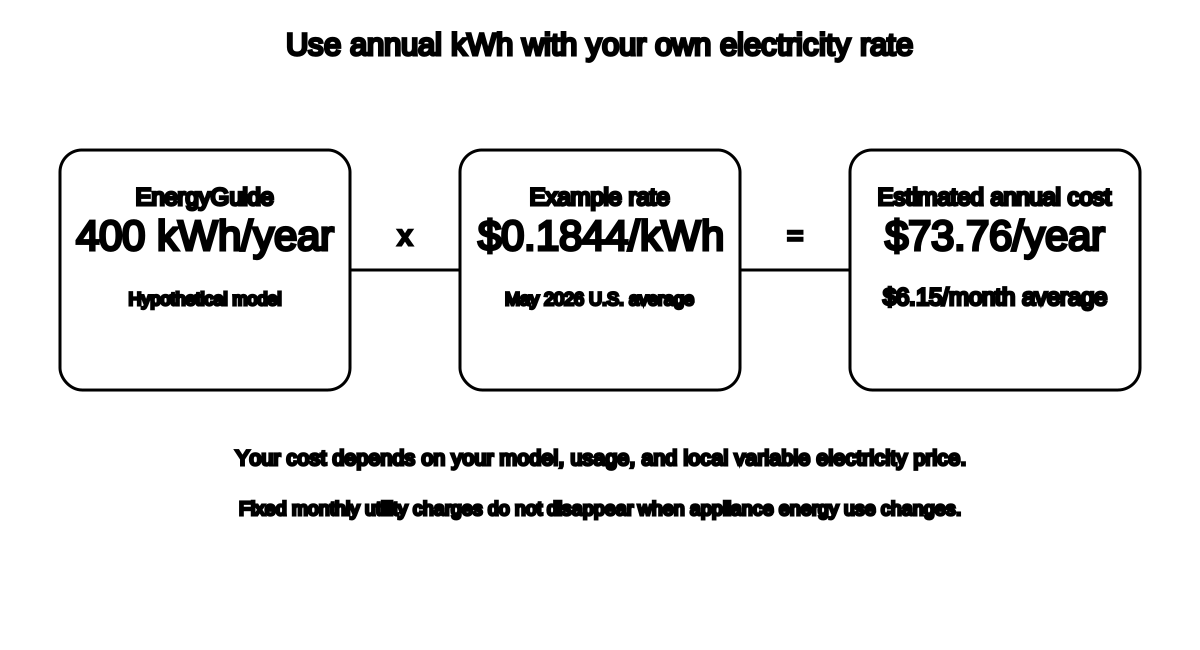
Hypothetical 400 kWh/year example using the May 2026 U.S. residential average. Use the exact model and local variable rate.
Suppose the EnergyGuide label shows:
- Annual energy use: 400 kWh
- Local electricity price: $0.1844 per kWh
Annual cost:
400 × $0.1844 = $73.76Monthly average:
$73.76 ÷ 12 = $6.15Daily average:
400 ÷ 365 = 1.10 kWh per day1.10 × $0.1844 \approx $0.20 per dayThese are averages. Refrigerators work harder during hot weather, after the door is opened, after warm food is added, and during defrost cycles.
Find annual kWh
Look for:
- Yellow EnergyGuide label
- Manufacturer model page
- Owner’s manual
- FTC appliance database or reported model data
- ENERGY STAR Product Finder for certified models
FTC requires EnergyGuide labels on refrigerators and refrigerator-freezers. The label helps compare similar models and reports estimated annual energy use.[1][2]
If the refrigerator is old and the label is missing, search the exact model number. Do not substitute a generic wattage for an unrelated refrigerator.
Why wattage is a poor refrigerator estimate
A refrigerator does not run its compressor continuously.
Electricity use changes with:
- Compressor cycling
- Defrost heater
- Fans
- Ice maker
- Control board
- Door openings
- Room temperature
- Food temperature
- Dirty or obstructed heat-exchange surfaces
- Door seals
- Size and configuration
Multiplying the compressor’s rated watts by 24 hours usually overstates normal use. Multiplying by a guessed duty cycle merely replaces one error with another.
Annual kWh already captures a standardized usage pattern.
Does an ENERGY STAR refrigerator cost less?
ENERGY STAR states that certified refrigerators are about 9% more efficient than models that meet the federal minimum energy-efficiency standard.[3]
That does not mean every certified refrigerator costs less than every non-certified refrigerator.
Compare models with similar:
- Size
- Freezer configuration
- Ice maker
- Through-the-door features
- Built-in versus freestanding design
- Intended use
A large feature-heavy refrigerator can use more electricity than a smaller simpler model even when both are efficient for their category.
How size affects cost
More refrigerated volume generally means more space to cool.
Do not buy substantially more refrigerator than the household needs solely because a sale makes the larger box look inevitable.
Compare:
- Annual kWh
- Usable capacity
- Storage layout
- Household needs
- Purchase price
Cost per cubic foot can be informative, but annual household cost is still annual kWh multiplied by the local rate.
Temperature setting
ENERGY STAR recommends keeping a refrigerator at 35°F to 38°F.[3]
FDA food-safety guidance requires 40°F or below.[4]
Use an appliance thermometer. The control dial may show a setting rather than actual temperature.
Do not raise the temperature above safe food-storage limits to save electricity.
Placement matters
ENERGY STAR recommends placing the refrigerator away from heat sources such as:
- Oven
- Dishwasher
- Direct sunlight
It also advises allowing air circulation behind the refrigerator and maintaining coils when the manual calls for it.[3]
Follow the exact model’s clearance and cleaning instructions. Some modern models conceal coils or use designs that should not be cleaned like older exposed-coil refrigerators.
Check the door seals
A damaged or dirty seal can let warm air enter.
Inspect for:
- Torn gasket
- Food residue
- Misaligned door
- Package blocking closure
- Door left slightly open
Clean and replace seals according to the manual.
Do not use a paper-slip test as the sole diagnosis of appliance failure. Seal designs and magnetic pressure vary.
The second refrigerator problem
A garage or basement refrigerator can add another full annual energy load.
Its cost may be higher when:
- It is older
- The room becomes hot
- The door seal is poor
- It is lightly used but always operating
- It is not designed for the garage temperature range
Use the exact annual kWh or measure over a representative period if the appliance is safely compatible with the meter.
A second refrigerator that costs $100 per year is not automatically wasteful if it provides real value. It is simply not free storage space conjured by the electrical grid.
Ice makers and door dispensers
Ice makers, heaters, displays, and through-the-door dispensers can add energy use.
Compare exact model labels rather than assigning a universal penalty.
If an ice maker is not connected or used, follow the manual for disabling it. Do not disconnect water lines casually.
When actual cost seems much higher
Possible causes include:
- Incorrect model estimate
- High local rate
- Hot room
- Door not closing
- Heavy door use
- Warm food added repeatedly
- Ice-maker use
- Mechanical problem
- Defrost problem
- A separate appliance being blamed
- Utility-rate or billing change
A high electric bill does not prove the refrigerator is failing.
Use utility interval data, a safe compatible meter, or professional diagnosis.
Repair versus replacement
Replacement may be worth considering when:
- The refrigerator cannot maintain safe temperature
- Repairs are frequent
- Annual kWh is much higher than comparable current models
- The door or insulation is damaged
- The appliance no longer meets household needs
Calculate:
Annual electricity savings =
(old annual kWh - new annual kWh)
×
rate
Do not claim a short payback without including purchase, delivery, installation, disposal, repair, and expected life.
Frequently asked questions
How much does a refrigerator cost per day?
Divide annual kWh by 365, then multiply by your rate.
Can I calculate cost from the compressor watts?
Not reliably. The compressor cycles and the refrigerator has other loads.
Does unplugging the refrigerator at night save money?
No safe household strategy involves repeatedly warming refrigerated food. Keep food at 40°F or below.
Does a full refrigerator use less electricity?
Thermal mass can reduce temperature swings, but blocking airflow or overpacking can impair cooling. Do not use this as a precise savings formula.
Should I replace an old working refrigerator?
Compare its annual energy use, repair condition, household need, and replacement cost. ENERGY STAR says old models generally use more energy, but the economics are model-specific.[3]
Related appliance and household-energy guides
- Calculate any appliance’s electricity cost
- Diagnose a high summer electric bill
- Use the printable home-energy check
- Use the refrigerator outage safety guide
Source notes
- How To Use the EnergyGuide Label To Shop for Home AppliancesFederal Trade Commission
- Energy and Water Use Labeling for Consumer Products Under the Energy Policy and Conservation ActFederal Trade Commission
- RefrigeratorsENERGY STAR
- Refrigerator Thermometers—Cold Facts about Food SafetyU.S. Food and Drug Administration
- Refrigerators & Freezers Key Product CriteriaENERGY STAR
- Purchasing Energy-Efficient Residential RefrigeratorsU.S. Department of Energy FEMP
See something wrong or out of date? Report a correction.