
How Much Does a Washing Machine Cost Per Load?
A hypothetical washer using 100 kWh per year and running 300 loads would average 0.33 kWh per load. At 18.44 cents per kWh, that is about 6 cents of electricity per load. Water, sewer, water-heater fuel, detergent, and dryer use are separate parts of total laundry cost.

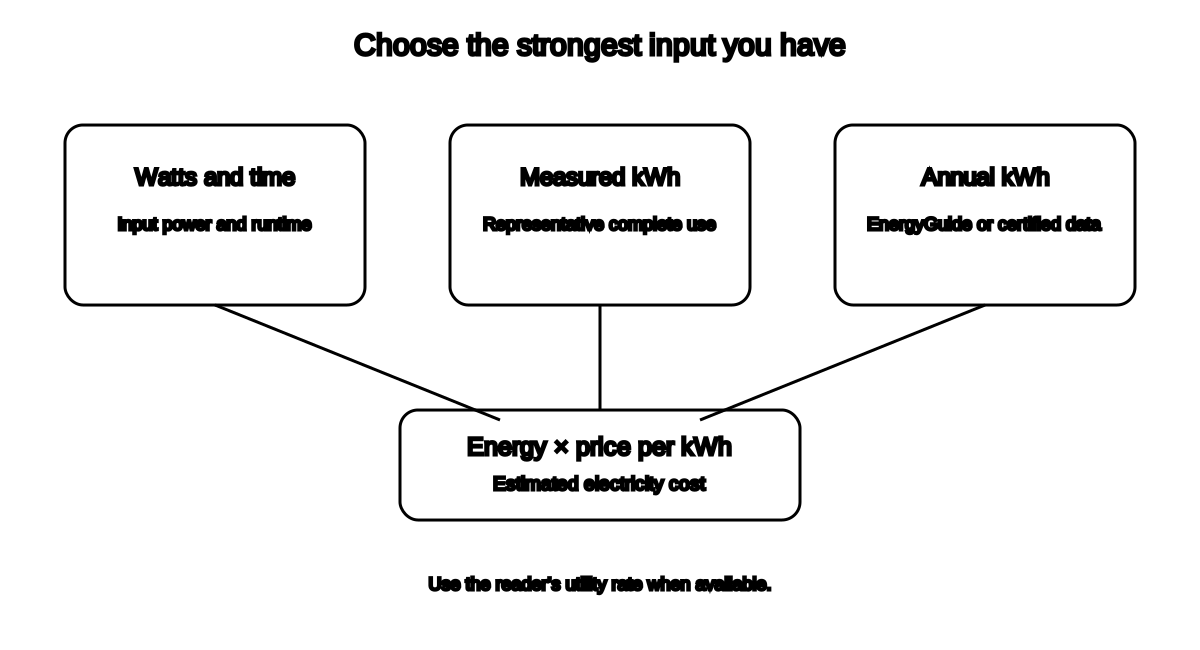
The most reliable way to estimate a washing machine’s electricity cost per load is:
\text(Electricity cost per load) =
\frac(\text(annual kWh))(\text(your annual loads))
\times
\text(electricity rate)
Use the model’s EnergyGuide annual kWh and the number of loads your household actually runs.
Quick answer: A hypothetical washer using 100 kWh per year and running 300 loads would average 0.33 kWh per load. At 18.44 cents per kWh, that is about 6 cents of electricity per load. Water, sewer, water-heater fuel, detergent, and dryer use are separate parts of total laundry cost.
Worked example
Suppose:
- Annual energy use: 100 kWh
- Household loads: 300 per year
- Electricity rate: $0.1844 per kWh
Energy per load:
100 \div 300 = 0.333 \text( kWh)Electricity cost:
0.333 \times \$0.1844 = \$0.0614About 6 cents per load.
Annual electricity cost:
100 \times \$0.1844 = \$18.44This is a hypothetical calculation, not a typical-washer promise.
Find annual kWh
Look at:
- Yellow EnergyGuide label
- Manufacturer model page
- ENERGY STAR Product Finder
- Official model specification
FTC requires EnergyGuide labels for residential clothes washers.[1]
The label uses federal test assumptions. It does not measure your household directly.
Use your actual number of loads
ENERGY STAR says the average American family washes about 300 loads per year.[2]
That is a useful example, not a required denominator.
Use:
- Utility or laundry records
- Loads per week multiplied by 52
- A realistic household estimate
If you run five loads per week:
5 \times 52 = 260 \text( loads per year)A 100 kWh-per-year washer would then average:
100 \div 260 = 0.385 \text( kWh per load)At $0.1844 per kWh:
0.385 \times \$0.1844 = \$0.071About 7 cents per load.
Why there is no universal per-load number
Federal test procedures use standardized cycles and assumptions. The applicable annual-cycle basis can vary with the test procedure used for the representation.
Household cost changes with:
- Hot, warm, or cold water
- Load size
- Cycle selected
- Water-heater fuel
- Washer design
- Standby power
- Remaining moisture
- Annual load count
- Local electricity price
Do not divide every washer’s annual kWh by the same internet number without checking the label and your own use.
Water heating usually matters more than the motor
ENERGY STAR states that water heating accounts for about 90% of the energy used to operate a clothes washer under its guidance assumptions.[2]
Cold washing can reduce energy use substantially when it is suitable for:
- Fabric
- Soil
- Detergent
- Household health needs
ENERGY STAR notes that switching from hot to warm can cut energy use in half, and cold reduces it further.[2]
Use hotter settings when:
- Care label requires it
- Oily soil needs it
- Illness or sanitation needs justify it
- Manufacturer instructions call for it
Energy savings do not override hygiene or fabric requirements.
The EnergyGuide estimate is not the whole laundry bill
Laundry can involve:
- Washer electricity
- Water-heater electricity, gas, or oil
- Water and sewer charges
- Detergent
- Dryer electricity or gas
- Maintenance
The washer label is a standardized energy-comparison tool. It is not a complete household laundry invoice.
Full loads improve cost per item
ENERGY STAR says clothes washers use about the same amount of energy regardless of load size, so full loads generally improve efficiency per garment.[2]
Do not overload:
- Clothes need room to move.
- Water and detergent must circulate.
- The machine must balance.
- Manufacturer capacity limits apply.
A failed overloaded cycle is not efficient.
High spin can reduce dryer cost
A faster final spin can remove more water and reduce dryer time.[2]
Use it when appropriate for the fabric and washer.
The electricity increase from spinning faster may be smaller than the dryer energy avoided, but exact savings are model- and load-specific.
Front load versus top load
ENERGY STAR reports that certified front-load washers use less energy and water than traditional top-load agitator models under its comparison.[2]
That does not make every front loader cheaper for every household.
Compare:
- Annual kWh
- Water use
- Capacity
- Purchase price
- Maintenance
- Accessibility
- Cycle time
- Household use
IMEF and IWF
ENERGY STAR provides two efficiency metrics:
- IMEF: Integrated Modified Energy Factor. Higher is better.
- IWF: Integrated Water Factor. Lower is better.[3]
IMEF considers washer energy, water heating, remaining moisture that affects drying, and low-power modes.
These are comparison metrics. For household cost, annual kWh and actual water use are easier to apply.
Do longer cycles cost more?
Not necessarily.
A longer cycle may use:
- Lower water temperature
- Less water
- Lower motor power
- More soaking
- Different spin profile
Use annual model data or a safe compatible measurement rather than clock time alone.
Can you use a plug-in meter?
Only when:
- Washer is a compatible 120-volt plug-in appliance
- Meter is rated for the load
- Manufacturer permits ordinary plug-in use
- Outlet, cord, and meter are undamaged
Do not use adapters, extension cords, or smart plugs unless both products explicitly permit the setup.
Do not use ordinary plug-in meters on 240-volt or hardwired laundry equipment.
Frequently asked questions
Does a cold wash use less electricity?
Usually, because less energy is needed to heat water. Use a hotter setting when the load or health situation requires it.
Does a half load cost half as much?
Usually not. ENERGY STAR says washer energy is similar across load sizes, though water-sensing behavior varies.
Is the EnergyGuide annual cost exact?
No. It uses standardized assumptions and a national energy price. Use annual kWh with your rate.
Does the label include dryer energy?
Washer efficiency metrics account for remaining moisture because it affects drying. Household dryer cost should still be calculated separately.
How can I lower cost per load?
Use full appropriate loads, cold water when suitable, efficient spin settings, and the correct cycle.
Related guides
- Calculate any appliance’s electricity cost
- Calculate electric-dryer cost per load
- Use the printable home-energy check
- Use the appliance electricity cost calculator
Source notes
- How To Use the EnergyGuide Label To Shop for Home AppliancesFederal Trade Commission
- Clothes WashersENERGY STAR
- Clothes Washers Key Product CriteriaENERGY STAR
- 10 CFR Part 430, Subpart BElectronic Code of Federal Regulations
- ENERGY STAR Certified Residential Clothes WashersENERGY STAR
See something wrong or out of date? Report a correction.