
Is Freezer Burn Safe to Eat?
Freezer burn itself does not make continuously frozen food unsafe, but it can make the food dry, tough, or stale-tasting.
What to know
- Freezer burn is a moisture-loss and quality problem.
- Continuous freezing and safe handling are separate from visible freezer burn.
- Trim damaged areas if practical, or discard food when its history is uncertain or spoilage is evident after thawing.
Freezer burn is generally a quality problem, not a safety verdict. USDA describes it as dry, grayish-brown, leathery areas caused by air reaching the surface of frozen food. Food with freezer burn can be safe if it stayed frozen and was otherwise handled safely, but the affected areas may taste dry or unpleasant. [2]
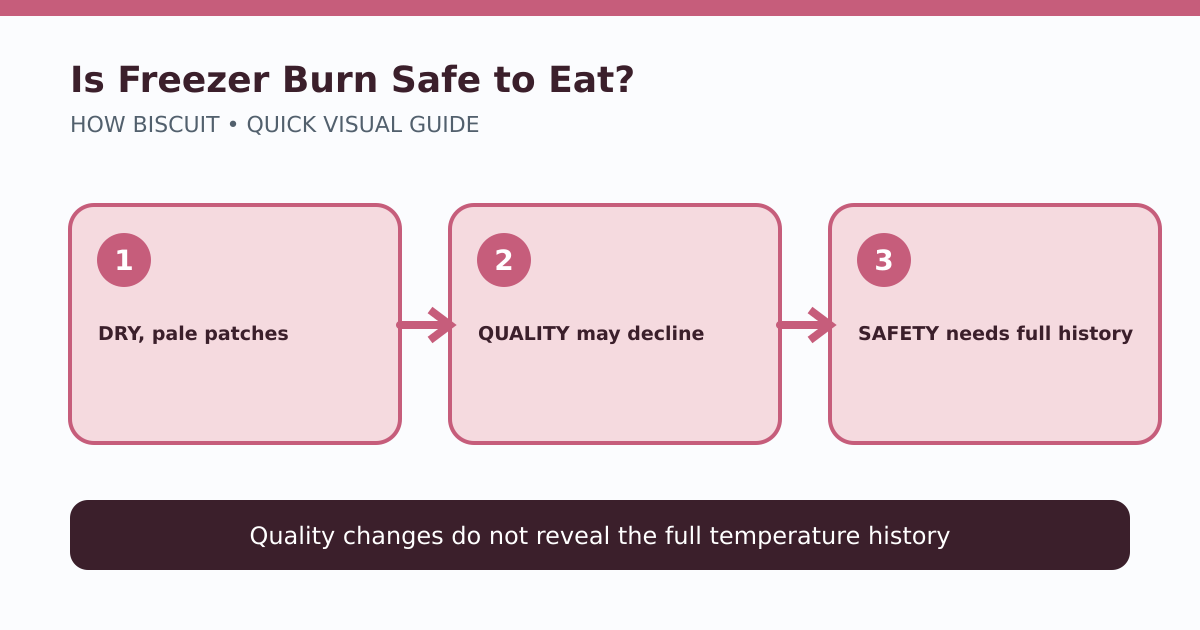
The diagram separates two questions people often combine. Visible dry patches tell you about moisture loss. They do not, by themselves, tell you whether the food thawed during an outage or was contaminated before freezing.
What freezer burn looks like
Common signs include pale or gray-brown patches, a dry surface, excess ice crystals inside a loosely sealed package, and a texture that becomes tough after cooking. Those signs appear when exposed areas lose moisture in the cold, dry freezer environment. The FDA likewise says freezer burn is a food-quality issue and does not mean the food is unsafe. [1]
Packaging matters because a tight moisture- and vapor-resistant wrap limits air contact. Pressing excess air from an appropriate freezer bag, using intact containers, and labeling the date can help preserve quality. These practices do not turn questionable food safe; they simply reduce exposure and make storage history easier to track.
Decide what to do
If the food remained continuously frozen, the package is intact, and freezer burn is limited, you can cut away the driest portion before or after cooking. Whether the rest is worth using is a quality judgment. A heavily burned item may be safe under those assumptions yet still produce a disappointing meal.
Use a different decision process when the food’s history is uncertain. A damaged seal, leakage, evidence that the food thawed, or a long unmonitored outage calls for federal thawing and outage guidance. USDA notes that freezing keeps food safe by slowing microbial activity, but it does not kill every organism. [2] Do not use a normal smell or the absence of freezer burn as proof that mishandled food is safe.
After thawing, color change alone is not a safety verdict; USDA notes that frozen foods can change color without becoming unsafe. [2] Use a safe, known temperature history as the primary decision boundary. An off odor or abnormal texture after thawing can be a reason to discard, but some hazards announce themselves through neither smell nor appearance. Never taste food to test its safety.
One practical quality check is to plan how the food will be used before thawing it. A dry edge may be easy to trim from a roast but impossible to separate from a small chopped portion. Choose a cooked preparation that can tolerate some texture loss, and discard the item if the result is not worth eating.
Prevent the next case
Keep the freezer at 0°F (-18°C), verify that temperature with an appliance thermometer, cool and package food appropriately, and choose a package that fits the amount of food without a large pocket of air. Avoid repeatedly opening a package for small portions; dividing food before freezing can reduce that exposure. Rotate labeled packages so older food gets used while its quality is still acceptable.
Limits of this guidance
This article does not assess a particular food item. Its answer depends on an important condition: the food stayed continuously frozen and was safely handled before freezing. Freezer burn cannot establish that history. When thawing, outage exposure, an open package, or contamination is possible, consult current USDA/FDA advice for the exact food and circumstances. The article makes no claim about flavor after damage and reports no tasting trial.
Limits and cautions
- This guidance assumes the food remained continuously frozen and was handled safely.
- Appearance alone cannot reconstruct a food package’s temperature history.
- No food was tasted or evaluated for this article.
Source notes
- Are You Storing Food Safely?U.S. Food and Drug Administration
- Freezing and Food SafetyUSDA Food Safety and Inspection Service
See something wrong or out of date? Report a correction.