
Why Is My Refrigerator Sweating?
Refrigerator condensation usually forms when humid air meets a cold surface; frequent door openings, a poor door seal, blocked airflow, or off-target temperature can make it worse.
What to know
- First note whether moisture is inside, outside, or actually leaking from one point.
- Check room humidity, door closure, gasket contact, blocked vents, and temperature.
- Persistent pooling, warming food, damaged seals, or electrical symptoms require model-specific service.
Refrigerator “sweat” is condensation: moisture in warmer air becomes liquid when it reaches a cold surface. High room humidity can cause droplets on the cabinet, while frequent door openings, a door that does not seal, or blocked interior airflow can increase moisture inside. First identify where the water appears before assuming the appliance is leaking. [1] [2]
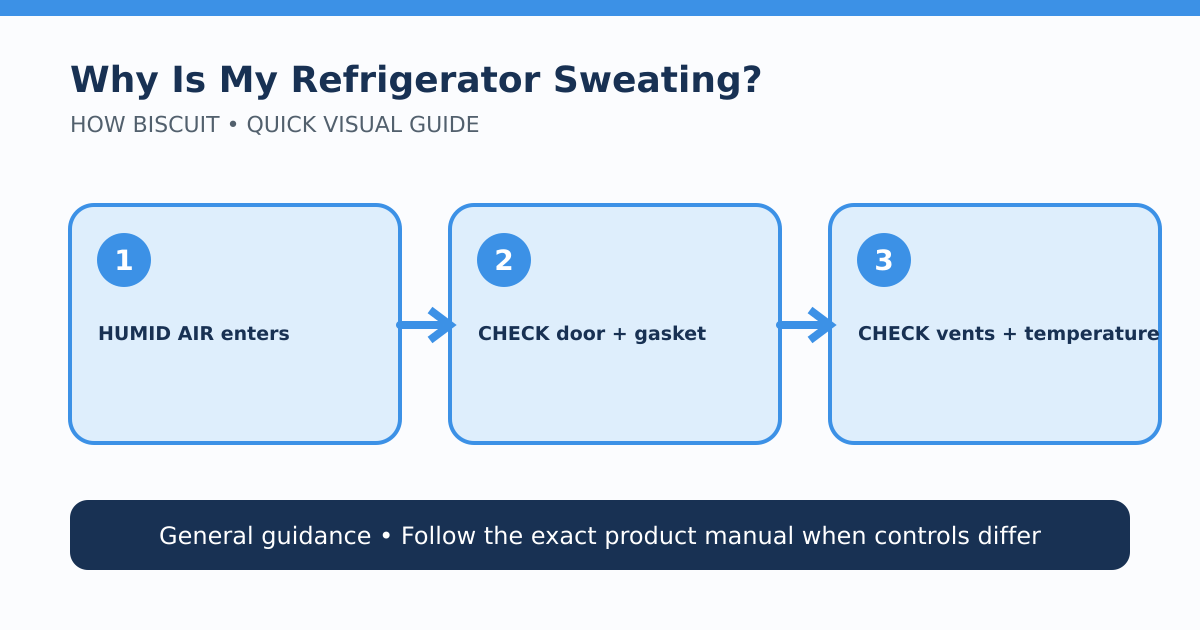
The lead diagram shows the useful path: start with humid air entry, then check closure and airflow, and finally verify actual temperature.
1. Map the moisture
Wipe the area dry and observe where water returns. Droplets spread across an exterior face in muggy weather suggest surface condensation. Beads on shelves or food packages point toward interior humidity. A puddle from one corner, a wet supply line, water beneath the appliance, or repeated water under a drawer may be a leak rather than ordinary sweating.
Do not pull a heavy refrigerator across a wet floor or reach behind a powered appliance. If water is near a receptacle, cord, or damaged wiring, keep clear and use a safe shutoff method before seeking qualified help.
2. Check the door and gasket
Move tall containers, bins, and packages that prevent the door from closing. Clean food residue from the gasket using the care method in the manual. Look for a folded, torn, loose, or hardened section. Whirlpool identifies frequent door openings and an improper seal as common contributors to cabinet or interior moisture. [1]
A paper-pull test is sometimes suggested online, but it is not a calibrated diagnosis and may not apply uniformly around complex door geometry. A visible gap, persistent light leak, damaged gasket, or door alignment problem deserves model-specific instructions.
3. Restore interior airflow
Food packed against vents can create warm pockets and moisture. Find the supply and return vents in the manual and leave their required clearance. Avoid placing uncovered hot food in the compartment; use appropriate covered storage and follow safe cooling guidance.
Whirlpool’s interior-condensation guidance lists blocked vents, door opening, gasket condition, leveling, and humid conditions among checks. [2] Those are possibilities, not proof that every wet refrigerator has the same cause.
4. Verify the temperature
The FDA says a refrigerator should be kept at or below 40°F (4°C) and recommends using an appliance thermometer. [3] A control dial is not a thermometer. Place an appropriate thermometer as directed, minimize unnecessary opening, and look for a stable reading.
If food is above the safe range or the appliance is warming, protect perishable food using current FDA/USDA guidance. Do not wait for condensation troubleshooting to resolve a food-safety problem. A colder-than-needed setting can also increase surface temperature differences and may freeze food, but change settings only in small, manual-directed steps.
5. Reduce the humidity load
In a humid room, use normal building ventilation or dehumidification when appropriate, keep doors closed, and let the refrigerator complete its recovery after loading. Make sure the model’s exterior moisture-control or energy-saver feature, if present, is set according to the manual. Those controls differ, so a generic switch position is not reliable advice.
When service makes sense
Arrange model-specific support when water keeps pooling, a gasket or hinge is damaged, the cabinet never reaches a safe temperature, fans make abnormal sounds, frost blocks airflow, a drain repeatedly overflows, or the unit shows an error. A technician can separate a drain, supply-line, defrost, fan, sensor, refrigerant, and cabinet-heater problem without guesswork.
Limits of this guidance
This is a source-based checklist, not a remote diagnosis or physical inspection. It cannot determine whether water is condensation, a plumbing leak, or a defrost-drain fault. The exact manual governs leveling, clearances, controls, cleaning, and service. Food that spent too long above a safe temperature requires a food-safety decision independent of the moisture repair.
Limits and cautions
- Condensation and leaks can have different causes that cannot be distinguished remotely.
- Acceptable exterior moisture and control settings vary by model and climate.
- No refrigerator was physically inspected for this article.
Source notes
- Moisture on the Outside of the CabinetWhirlpool Product Help
- Condensation in the Refrigerator SectionWhirlpool Product Help
- Are You Storing Food Safely?U.S. Food and Drug Administration
See something wrong or out of date? Report a correction.