
Why Is My Smoke Alarm Chirping?
An intermittent chirp commonly signals a low battery, end-of-life condition, or another model-specific fault; first distinguish it from a full alarm and identify the exact unit.
What to know
- If the alarm is sounding for smoke or carbon monoxide, leave and call emergency services from outside.
- For a chirp, identify the device, read its pattern, check the battery and age, and follow the manual.
- Never disable protection or assume every brand uses the same chirp code.
A periodic smoke-alarm chirp often means a low battery, an end-of-life warning, or a model-specific trouble condition. But do not troubleshoot a sound until you distinguish a chirp from an active smoke or carbon-monoxide alarm. If there may be smoke or fire, get everyone outside and call emergency services from a safe location. USFA says occupants should get outside when a smoke alarm sounds. [2] If carbon monoxide is suspected, CPSC says to get to fresh air immediately and call 911. [3]
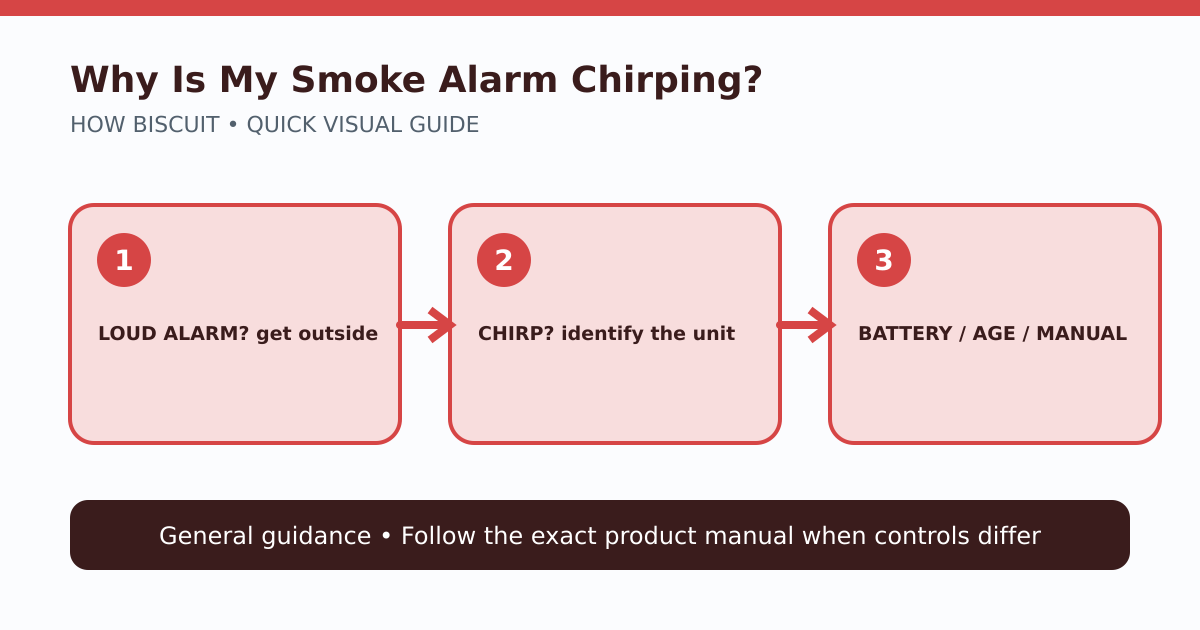
The lead diagram establishes the safe order: emergency response first, maintenance diagnosis only after an active hazard is ruled out.
1. Find the device making the sound
Short chirps bounce off walls and can be hard to locate. Check every smoke alarm, combination smoke/CO alarm, standalone CO alarm, and nearby device with a warning buzzer. Look for a flashing indicator synchronized with the sound, but do not climb unsafely. Ask another person to listen from a different location.
Once identified, record the manufacturer and model number. Signal patterns are not universal. One chirp every interval can mean something different from several chirps, and a smoke alarm’s pattern can differ from a carbon-monoxide alarm made by the same brand.
2. Check the battery correctly
The U.S. Fire Administration describes a low-battery warning as a chirping or high-pitched signal on battery-operated smoke alarms. [1] Replace a removable battery with the type specified on the alarm or in its manual, observing polarity. Close the battery door fully and use the test procedure in the manual.
Some alarms have sealed batteries that are not designed for owner replacement. Do not pry open a sealed unit. A sealed model that signals end of life may require replacement of the alarm itself.
3. Check the manufacturing or replace-by date
Kidde lists low battery and end of unit life among causes of chirping, while directing owners to the sound pattern for the specific alarm. [4] Find the label without disconnecting protection longer than necessary. Compare its date and signal pattern with current manufacturer instructions.
If you replace a unit, use a compatible alarm suitable for the location and follow applicable code and installation instructions. Interconnected alarms can have compatibility requirements that a visually similar device does not meet.
4. Consider temperature and installation conditions
Kidde notes that lower nighttime temperatures can reduce an already weak battery’s output enough to trigger a low-battery chirp. [5] That explains why a marginal battery may announce itself at night; it is not a reason to ignore the warning until morning.
Dust, a partially closed battery drawer, loss of household power on a hardwired unit, or another trouble state may also produce signals on some models. Use the manual’s cleaning, reset, and power instructions. Never spray cleaner or paint into an alarm.
5. Test without disabling protection
After the specified correction, use the alarm’s test button as the manual directs. A button test is a functional check, not proof that every sensor will respond correctly in every fire. If chirping continues, the pattern is not listed, the unit is damaged, or interconnected alarms behave unexpectedly, contact the manufacturer or a qualified alarm professional.
Do not remove the battery and leave the alarm disabled. Do not cover it to silence nuisance alarms. Address cooking placement or recurring nuisance behavior using code-compliant manufacturer guidance.
Limits of this guidance
This desk-researched checklist cannot identify a sound remotely or rule out smoke or carbon monoxide. The exact alarm label and manual control the interpretation. Local fire-code requirements, landlord responsibilities, and interconnected system design may add obligations. An active alarm or symptoms such as headache, dizziness, or nausea require emergency action, not a battery experiment. [3]
Limits and cautions
- Alarm patterns, battery types, end-of-life signals, and reset steps vary by model.
- This article cannot determine whether smoke or carbon monoxide is present.
- No alarm was evaluated for this article.
Source notes
- Fire Safe Seniors Implementation GuideU.S. Fire Administration
- Smoke AlarmsU.S. Fire Administration
- Carbon MonoxideU.S. Consumer Product Safety Commission
- Smoke Alarm Sound CausesKidde
- Nighttime Alarm ChirpsKidde
See something wrong or out of date? Report a correction.