
What Size Air Purifier Do You Need?
Measure the actual room, use the smoke CADR when fine-particle removal is the goal, and choose a unit that can provide the required CADR at a noise level you will actually tolerate.

Size a portable air cleaner using:
- Room area
- Ceiling height
- Clean Air Delivery Rate
- Target particle
- Required operating speed
- Room layout
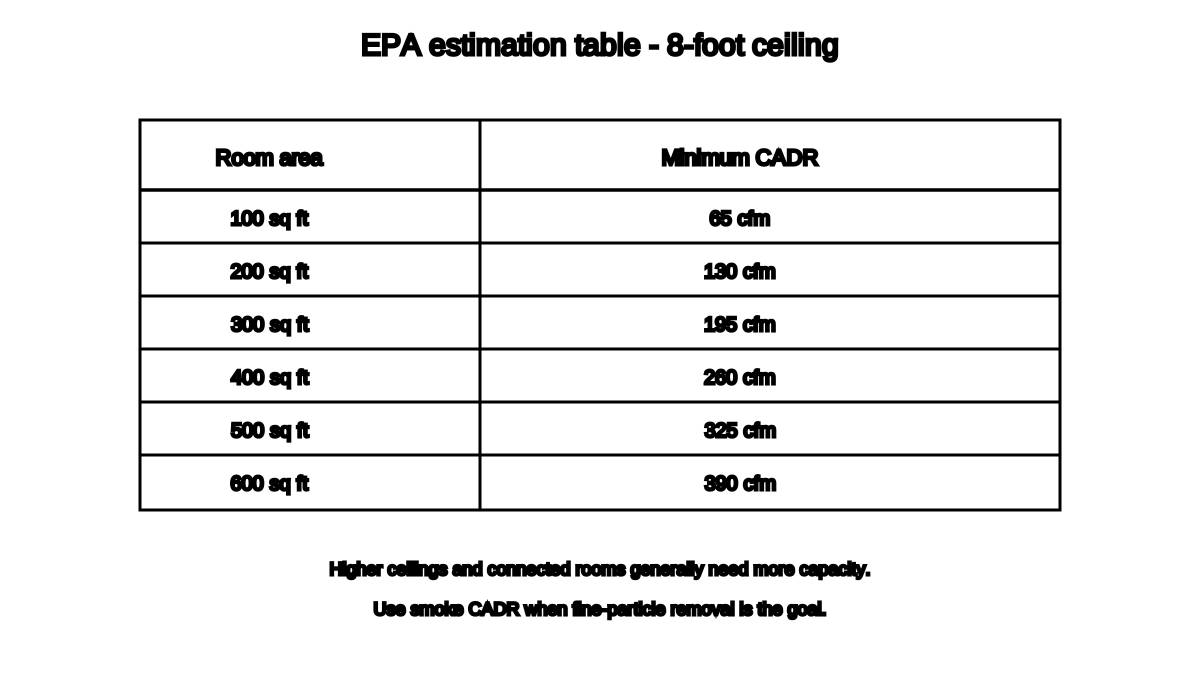
EPA’s current estimation table uses a minimum CADR of approximately 65 cubic feet per minute for each 100 square feet at an eight-foot ceiling.[1]
Quick answer: Measure the actual room, use the smoke CADR when fine-particle removal is the goal, and choose a unit that can provide the required CADR at a noise level you will actually tolerate.
Measure the room

For a rectangular room:
Area
=
length
\times
width
A 12-by-15-foot room is:
12 \times 15 = 180 square feetFor an irregular room:
- Divide it into rectangles.
- Calculate each area.
- Add them.
Do not use the entire house square footage for a unit placed in one closed bedroom.
EPA room-size table
EPA and ENERGY STAR currently provide this estimation table for an eight-foot ceiling:
| Room area | Minimum CADR |
|---|---|
| 100 sq ft | 65 cfm |
| 200 sq ft | 130 cfm |
| 300 sq ft | 195 cfm |
| 400 sq ft | 260 cfm |
| 500 sq ft | 325 cfm |
| 600 sq ft | 390 cfm |
The table is an estimate, not a promise that every room with the same floor area behaves identically.[1][2]
Ceiling height

The EPA table assumes an eight-foot ceiling.
A higher ceiling means more air volume.
A simple volume comparison is:
Room volume
=
area
\times
ceiling height
A 300-square-foot room with a 12-foot ceiling contains 50% more air than the same floor area with an eight-foot ceiling.
EPA advises selecting a higher CADR when ceilings are higher.[1]
Do not treat a rough height adjustment as a certified room-size claim for a particular model.
What CADR measures
Clean Air Delivery Rate describes the amount of filtered air delivered for a particular particle class.
Labels may report CADR for:
- Smoke
- Dust
- Pollen
- PM2.5
Higher CADR generally means faster particle removal and a larger suitable area.
CADR is usually measured at the highest fan speed.
A unit may be much quieter and less effective at its lowest speed.
Use smoke CADR for fine particles
EPA advises looking at the tobacco-smoke CADR when targeting small particles such as PM2.5.[1]
That does not mean the purifier removes:
- Carbon monoxide
- Carbon dioxide
- Radon
- Every VOC
- Every odor
- All infection risk
CADR is a particle-delivery metric.
Open floor plans
An open plan complicates sizing because:
- Air moves between zones.
- Ceilings may differ.
- Doors and hallways affect circulation.
- Pollutant sources may be distant.
- One unit may not mix air evenly.
Options:
- Size for the connected area.
- Use multiple units.
- Place units near occupied zones.
- Close doors to create a clean room during smoke.
- Combine with compatible central filtration.
One giant unit at the opposite end of an L-shaped floor plan may not serve every corner effectively.
Bedrooms
For a bedroom, consider:
- Closed-door area
- Sleep noise
- Display brightness
- Filter availability
- Required overnight speed
- Child or pet access
- Clearance around inlet and outlet
A unit sized only at maximum speed may be too loud to use at night.
Choose enough capacity that the required filtration can occur at a tolerable setting.
Placement
Follow the manual.
In general:
- Keep inlet and outlet clear.
- Avoid curtains.
- Avoid tight corners.
- Keep away from heat and moisture.
- Do not cover the unit.
- Do not block doors or exits.
- Avoid unapproved extension cords.
- Keep it stable.
ENERGY STAR advises placing the unit where airflow is not obstructed.[2]
Multiple smaller units versus one large unit
Multiple units may be useful when:
- Rooms are separated.
- Doors remain closed.
- Pollutants occur in several zones.
- One unit cannot circulate air through the layout.
- Noise distribution matters.
One larger unit may be simpler when:
- The space is open.
- Placement is central.
- Filter availability is good.
- Noise is acceptable.
Compare total CADR, power, filter cost, and placement.
Do not size by marketing room claims alone
A package may advertise a very large room using:
- One air change per hour
- Maximum speed
- Proprietary assumptions
- Open-space assumptions
Check:
- CADR
- Test method
- Ceiling assumption
- Fan speed
- Pollutant type
- Source of the room claim
The EPA table provides a common public-health starting point.
Example
Room:
- 14 feet by 16 feet
- 8-foot ceiling
Area:
14 \times 16 = 224 sq ftThe EPA table falls between:
- 200 sq ft: 130 cfm
- 300 sq ft: 195 cfm
A practical target would be at least the interpolated requirement, with additional capacity for:
- Higher ceiling
- Smoke
- Open door
- Low-noise operation
- Poor mixing
Do not round down merely because the smaller unit is on sale.
Frequently asked questions
What CADR do I need for 200 square feet?
EPA’s current estimate is 130 cfm at an eight-foot ceiling.
Can I oversize an air purifier?
A larger unit can run at lower speed, but purchase price, filter cost, size, and minimum fan behavior matter.
Does HEPA replace CADR?
No. Filter type and delivered airflow both matter.
Should I use dust or smoke CADR?
Use smoke CADR when fine particles are the primary concern.
Does one purifier work through an open door?
Some air may exchange, but performance in another room is not guaranteed.
Printable companion
Download the ungated HVAC Filter Log PDF. No email address is required.
Related guides
- What MERV Rating Should You Use in Your House?
- How Often Should You Change Your HVAC Filter?
- Air Purifier vs. HVAC Filter: Which Do You Need?
- How Much Does an Air Purifier Cost to Run?
- What Can an Air Purifier Remove?
- What Humidity Should Your House Be?
- Home Energy Check for a High Summer Electric Bill
- Why Is My Electric Bill So High in Summer?
- How to Calculate What an Appliance Costs to Run
Source notes
- Guide to Air Cleaners in the HomeEPA
- Air CleanersENERGY STAR
- Room Air Cleaner Key Product CriteriaENERGY STAR
See something wrong or out of date? Report a correction.