
How to Read an EnergyGuide Label
Read the model and capacity first, then annual kWh or fuel use, then the comparison range. Treat the printed operating cost as a standardized estimate based on a national energy price, not your personal bill.

The most reusable number on an EnergyGuide label is usually the product’s estimated annual energy use.
Use that number with your own electricity or fuel rate.
Quick answer: Read the model and capacity first, then annual kWh or fuel use, then the comparison range. Treat the printed operating cost as a standardized estimate based on a national energy price, not your personal bill.
What the label is

EnergyGuide is the yellow energy-information label required on many covered home appliances.
FTC states that it helps consumers:
- See how much energy an appliance uses
- Compare similar appliances
- Estimate operating cost[1]
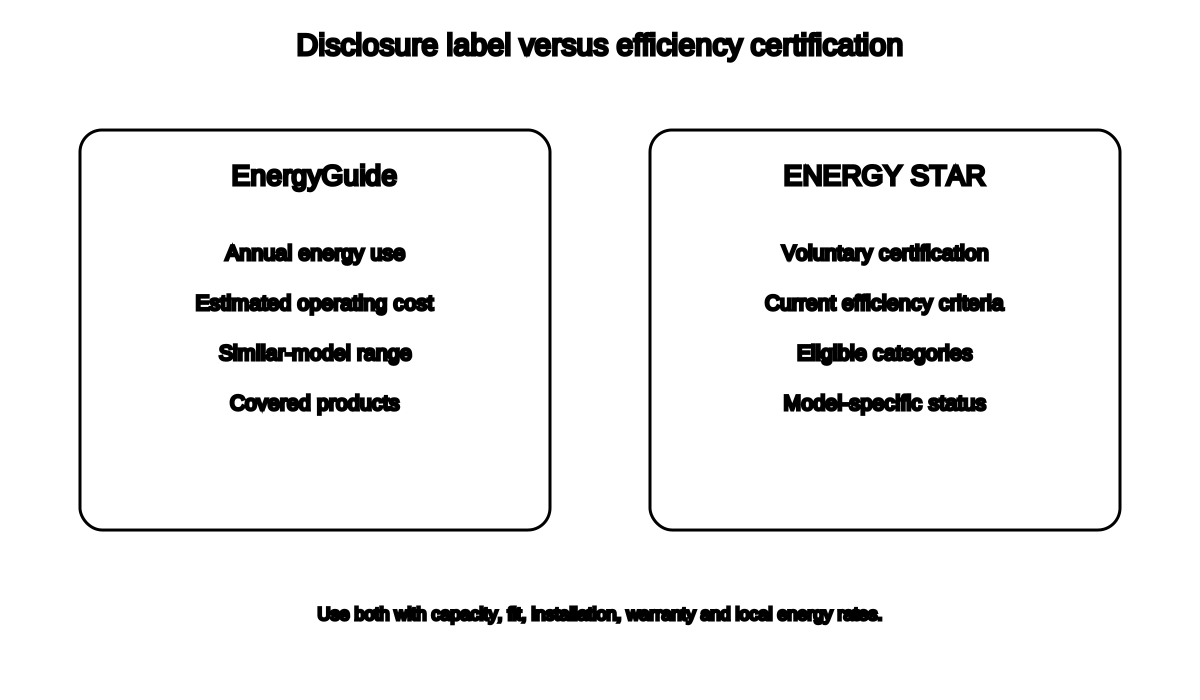
It is not the same thing as ENERGY STAR.
Product and model
Confirm:
- Product type
- Manufacturer
- Model number
- Capacity
- Configuration
The comparison range only makes sense among similar products.
A 28-cubic-foot refrigerator should not be compared casually with a 16-cubic-foot refrigerator.
A compact dishwasher should not be compared with a standard-capacity dishwasher without context.
Estimated annual energy use
.jpg)
This may appear as:
- kWh per year
- therms per year
- another standardized fuel unit
For electricity:
Annual cost
=
annual kWh
\times
local rate
Example:
- 400 kWh per year
- Local rate: $0.1844 per kWh
400 \times \$0.1844
=
\$73.76
Use the Appliance Electricity Cost Calculator for a local-rate estimate.
Estimated annual operating cost
FTC explains that the label’s cost uses standardized assumptions and a national energy price.[1]
Actual cost depends on:
- Local rate
- Usage
- cycle selection
- climate
- household size
- water temperature
- installation
- maintenance
- product condition
Do not rank products by the printed dollar estimate without checking the rate basis.
Comparison range
The label often shows where the product falls among similar models.
Use the range to ask:
- Is this near the low-energy end?
- Is the category defined correctly?
- Does capacity match?
- Are features comparable?
- Is the label current?
- Is the model exact?
The range may change when federal comparison data or product categories change.
Features and capacity
Efficiency is not the only decision.
Compare:
- Capacity
- doors
- freezer configuration
- heated dry
- connected features
- ice maker
- cycle options
- venting
- fuel
- standby functions
A larger or feature-heavy appliance may use more energy while still being efficient for its category.
Covered products
FTC’s current consumer list includes many products such as:
- Boilers
- ceiling fans
- central air conditioners
- clothes washers
- dishwashers
- freezers
- furnaces
- heat pumps
- pool heaters
- refrigerators
- televisions
- water heaters
- window air conditioners[1]
Not every household appliance has an EnergyGuide label.
A missing label on an uncovered category is not proof that a seller removed it.
EnergyGuide online
For online sales, energy information may appear:
- In product images
- In technical documents
- In label links
- In model databases
Verify the exact model.
Retailer listings can combine several variants.
Do not use one model’s label for another color, capacity, voltage, or configuration unless the energy data is identical and documented.
Recalculate with your rate
Use the variable rate affected by additional energy use.
Do not include a fixed monthly customer charge that remains even if the appliance is removed.
For time-of-use plans:
Total
=
(peak kWh \times peak rate)
+
(off-peak kWh \times off-peak rate)
A standard annual label does not know when your household runs the appliance.
What the label does not tell you
It does not fully describe:
- Reliability
- repair cost
- noise
- usability
- cleaning performance
- temperature consistency
- parts support
- warranty quality
- installation fit
- delivery damage
- retailer service
- lifetime
Use it as one evidence source.
Lifetime cost
A simple comparison:
Ownership cost
=
purchase
+
installation
+
energy
+
maintenance
+
repairs
-
verified rebates
Do not pretend repair costs are known precisely.
Use ranges and explicit assumptions.
Frequently asked questions
Is a lower annual cost always better?
Only when product size, features, and use are comparable.
Is EnergyGuide mandatory?
It is required for covered product categories under FTC rules.
Does the label include fixed utility charges?
The estimate uses energy consumption and an assumed energy price, not every household billing component.
Should I use the dollar amount or kWh?
Annual kWh is usually more reusable because you can apply your own rate.
Is the label a warranty?
No.
Printable companion
Download the ungated Appliance Purchase and Delivery Checklist PDF. No email address is required.
Related guides
- ENERGY STAR vs. EnergyGuide
- Are Extended Warranties on Appliances Worth It?
- Repair or Replace an Appliance?
- New vs. Used vs. Refurbished vs. Open-Box Appliances
- Appliance Buying Checklist: Measurements, Hookups, Delivery, Warranty, and Recalls
- How to Calculate What an Appliance Costs to Run
- How Much Does a Refrigerator Cost to Run?
- How Much Does a Dishwasher Cost Per Load?
- How Much Does a Washing Machine Cost Per Load?
- How Much Does an Electric Dryer Cost Per Load?
Source notes
- How To Use the EnergyGuide Label To Shop for Home AppliancesFederal Trade Commission
- Energy and Water Use Labeling for Consumer Products Under the Energy Policy and Conservation ActFederal Trade Commission
See something wrong or out of date? Report a correction.